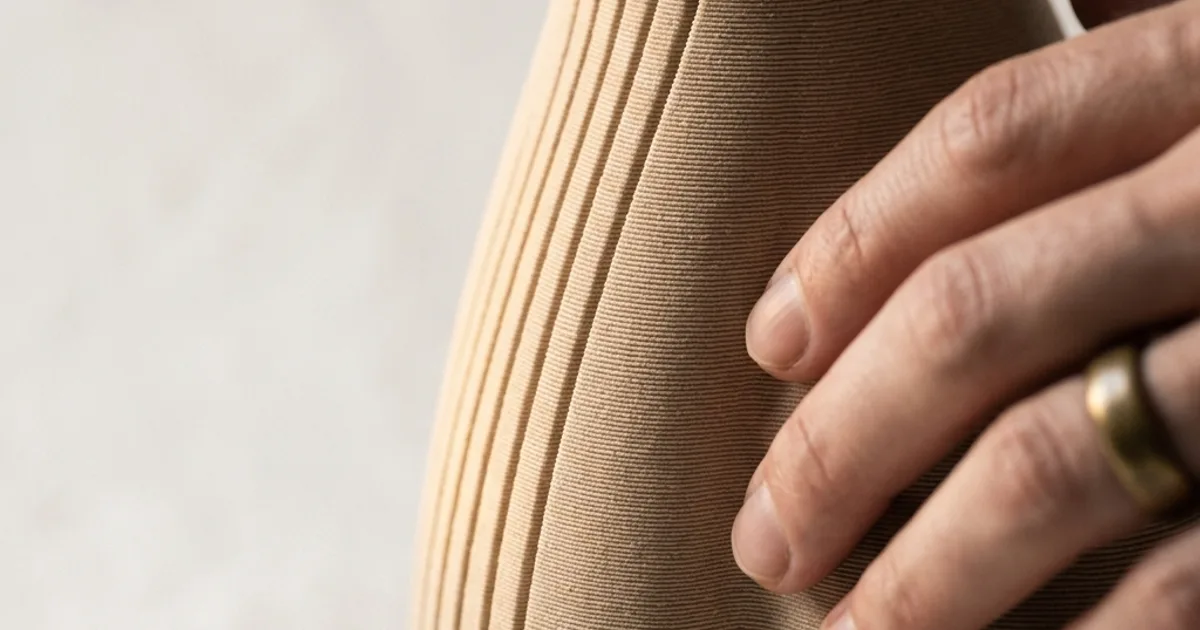
Is a 3D-printed object really solid and durable?
The reputation for fragility of 3D printing dates from another era. Real mechanical resistance of PLA, the role of walls and infill, limits when exposed to heat, and the gestures that make a piece last: the honest answer from a workshop that manufactures everything itself.
By L'atelier RE3DLINE
Yes, a 3D-printed object is solid and durable for decorative use: the PLA we use offers mechanical resistance comparable to conventional industrial plastics, and a well-printed piece will last for years without weakening. Its real limit is not impact, it is heat. We explain everything, from the workshop.
Where does the doubt about solidity come from?
The 3D-printed object carries a reputation for fragility inherited from the early days of the technology, when consumer-grade printers produced pieces with poorly bonded layers that would delaminate at the slightest impact. That era is over. Researchers at Michigan Tech University measured as early as 2014 that PLA pieces printed by filament deposition achieve average tensile strength of around 57 MPa, a level comparable to, or even exceeding, that of ABS-injected pieces, the plastic of Danish building bricks that generations of children have never managed to break.
In other words: the material is solid. What makes the difference between a fragile piece and a durable one are the manufacturing choices. And that is precisely where the fact that we produce ourselves, in our Guérande workshop, changes everything.
What makes a piece solid: walls, infill, orientation
A 3D-printed piece is not solid throughout. It consists of outer walls and an internal infill structure, invisible, that gives it rigidity. Three parameters determine its durability:
Wall thickness. This is what withstands everyday handling. Our vases, statues and lamps are printed with walls dimensioned for their actual use, not at the minimum technical thickness that saves a few grams of material.
Infill density and pattern. Inside, a geometric structure stiffens the piece, much like the ribs of an aircraft wing. A decorative object does not need to be solid throughout to be rigid: it needs well-thought-out infill.
Layer orientation. A printed piece resists better in the direction of the layers than perpendicular to them. Each model in our catalogue is oriented on the build plate so that everyday stresses act in the right direction. This is workshop know-how, invisible in the photo, decisive over time.
And over time: does it last?
Indoors, a PLA object is remarkably stable. It does not yellow like some older plastics, does not warp under its own weight and fears neither dust nor the light of a living room. A vase, statue or catchall placed on a shelf undergoes virtually no mechanical stress: at this rate, its lifespan is measured in decades.
PLA has one real weakness, and we prefer to name it rather than hide it: heat. It begins to soften between 55 and 60 degrees Celsius. No interior reaches these temperatures, but a car's rear shelf in the height of summer or the top of a stove does. For anything that lives outdoors or near a heat source, the reference material is recycled PETG, which holds between 75 and 85 degrees Celsius and withstands UV: it will join our workshop in the coming months. Until then, our PLA pieces are reserved for indoors and shaded outdoor use, as we explained in our guide to summer decor that holds up outdoors.
On the environmental side, this durability also changes the material's balance sheet: an object that lasts for years is nothing like disposable plastic. We have devoted an entire article to the question, without mincing words: is PLA really ecological?
What a 3D-printed decorative object can withstand (and what to avoid)
Concretely, in everyday life, our pieces withstand normal handling without flinching: they are moved, dusted, water is changed in a vase, a child picks them up. A fall onto tiles from a shelf can mark a thin piece, just as it would chip ceramic; the difference is that a printed object rarely breaks cleanly, it absorbs impact.
Three gestures are enough for a piece to last for years:
Avoid direct heat sources: radiator, stove, car rear shelf, dishwasher.
Clean by hand, with warm soapy water and a soft cloth.
Reserve pieces for indoors or shaded outdoor use: our current catalogue is printed in PLA, designed for the home. Recycled PETG, built for outdoors, is arriving at the workshop in the coming months. If you are unsure about a model, the product sheet specifies the intended use.
On these pieces, solidity quickly joins design: a full silhouette, wide at the base, absorbs impact better than an open form. We detail this choice in our article on the 3D-printed dog statue.
The guarantee of a workshop that manufactures itself
Everything above is only valuable if someone actually inspects each piece. With us, the printer that makes your object is just a few metres from the table where it is deburred, finished by hand and inspected before packing. No outsourcing, no container from far away: a piece that shows a layer defect never leaves for you, it goes back to the workshop's recycling.
This is also what allows us to answer precisely when you ask us about the solidity of a model for a particular use: we have printed it, handled it, tested it. Browse our collections, each piece is made to order in 5 to 7 days, in a palette of around twenty colors. And if a question remains open, write to us: no one knows the piece better than the workshop that made it.
RE3DLINE workshop, Guérande
Sources
To go further, the mechanical data cited in this article come from public works and references:
Tymrak B.M., Kreiger M., Pearce J.M., "Mechanical properties of components fabricated with open-source 3-D printers under realistic environmental conditions", Materials & Design, vol. 58, 2014: sciencedirect.com
Prusa Research, comparative table of 3D printing materials (PLA and PETG deflection temperatures): help.prusa3d.com
Frequently asked questions
- Does a 3D-printed object break easily?
- No. The PLA we use offers tensile strength of around 57 MPa, comparable to conventional injected plastics like ABS. A well-printed decorative piece, with properly dimensioned walls and suitable infill, easily withstands everyday handling. Like ceramic, it can mark when dropped on hard flooring, but it rarely breaks cleanly.
- How long does a 3D-printed object last?
- Indoors, its lifespan is measured in decades: PLA does not yellow, does not warp under its own weight and fears neither dust nor the light of a living room. Its only real limit is heat, it begins to soften between 55 and 60 degrees Celsius, a temperature no interior reaches.
- Can a 3D-printed object be left outside in the sun?
- Not in direct sunlight: the PLA of our current pieces warps under high heat, we reserve it for indoors and shaded outdoor use. Recycled PETG, a material that holds between 75 and 85 degrees Celsius and resists UV, will join our workshop in the coming months and open our collections to the outdoors. If in doubt, simply write to us.
- How do you care for a 3D-printed object to make it last?
- Three gestures are enough: keep it away from direct heat sources (radiator, dishwasher, car in summer heat), clean it by hand with warm soapy water and a soft cloth, and choose the right material for outdoor use. At this rate, the piece will last for years without weakening.