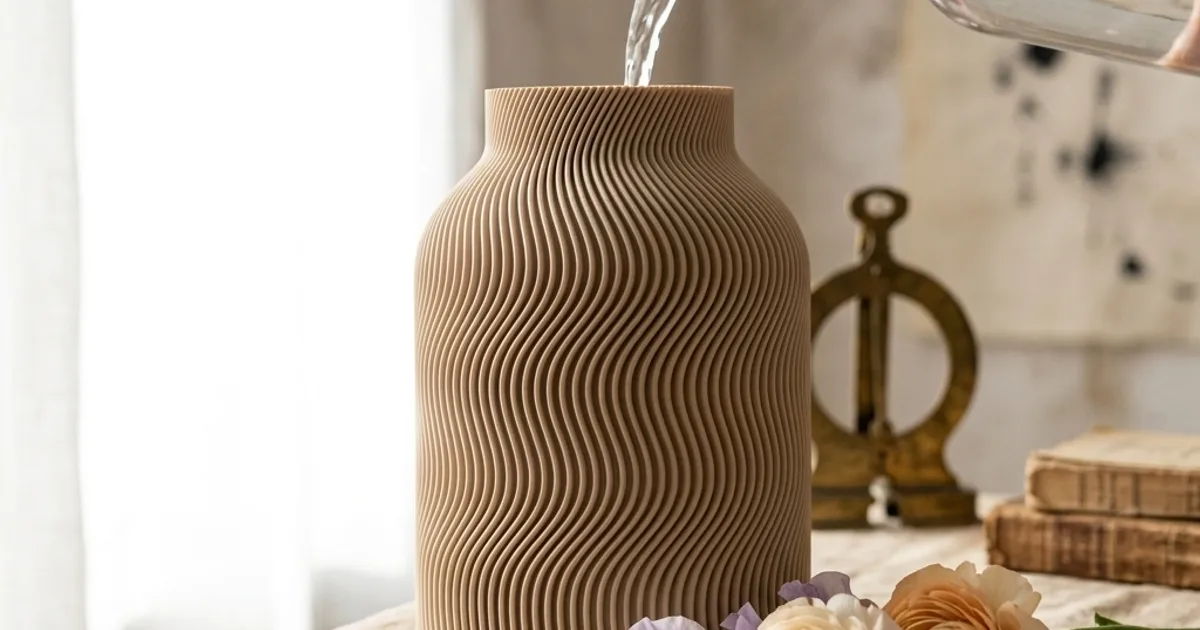
Can you put water in a 3D-printed vase?
It's the question we're asked most at the workshop. Short answer: yes, because our vases receive a waterproofing treatment before dispatch. Long answer: here's why a 3D-printed object isn't waterproof by nature, what we do about it, and the right practices to make it last.
By L'atelier RE3DLINE
Yes, you can put water in our 3D-printed vases: each piece receives a waterproofing treatment at the workshop that seals its walls before dispatch. Without this treatment, a 3D-printed object isn't waterproof by nature. Here's why, and the right practices to keep your vase in perfect condition.
Why 3D printing isn't waterproof by nature
A 3D-printed vase is built layer by layer: a thread of melted material is deposited in successive strata, each just a few tenths of a millimetre thick. This is what gives our vases their distinctive striped texture, and it's also the technique's Achilles heel: between two layers remain micro-gaps, invisible to the naked eye.
When dry, no problem at all. But fill an untreated printed vase with water, and physics does its work: through capillary action, water eventually finds its way through these gaps. Not a dramatic leak, more a slow seeping that leaves a ring under the vase after a few hours. On a wooden piece of furniture, that's the kind of surprise you'd rather avoid.
It's a point many 3D-printed object sellers prefer to gloss over, vaguely suggesting "dried flowers instead". We prefer to say it plainly, and more importantly, to solve it.
What we do at the workshop: a resin that seals the walls
Every vase that leaves our Guérande workshop receives a waterproofing treatment before dispatch: a technical resin is applied inside the vase, where it penetrates the walls through capillary action, exactly where water would try to seep through. As it hardens, it seals the micro-gaps between layers.
The result is invisible: the striped texture remains intact, the colour doesn't change, the vase doesn't shine. It simply becomes waterproof, and works like a regular vase, water included. Once hardened, the resin is completely inert: it's harmless to your flowers and plants, and the vase water remains ordinary water. No glass insert to slip inside, no hidden container: it's the printed wall itself that's treated, and the interior volume stays complete for your stems.
The right practices: cold water, hand washing
Our vases are printed in PLA, a biosourced material of plant origin whose true environmental balance we've detailed here. Its only real limitation is heat: PLA begins to soften between 55 and 60 degrees Celsius. Three simple rules follow from this:
Cold or room-temperature water. That's what cut flowers prefer anyway: warm water speeds up their wilting. Change the water every two or three days, as you would with any vase.
Never in the dishwasher. Dishwasher cycles go well above 60 degrees Celsius. A hand rinse with warm soapy water is more than enough, and the treated interior cleans easily.
Away from strong heat sources. A bright windowsill poses no problem at all, but avoid the top of a radiator in the depths of winter or the rear shelf of a car in summer.
Dried flowers: zero constraints, zero maintenance
If you're more into pampas grass, lagurus, statice or everlasting flowers, the water question doesn't even arise. A 3D-printed vase welcomes dried and stabilised flowers with no special precautions whatsoever: no water, no risk of rings, no maintenance. It's the perfect match between a composition that lasts for years and an object made to last just as long.
Which vase for which use?
Once the water question is settled, there's the matter of shape: a round bouquet, tall stems or a single flower each call for a different vase. We've put together a complete guide on this: how to choose a vase for your flowers. In short: a generous belly and a narrow neck for the florist's bouquet like our Nami, a wide base for tall stems, a narrow neck for the single-stem vase.
All models in our vase collection come in around twenty colours, and each piece is printed to order in our Guérande workshop, treated, then dispatched within 5 to 7 days. Any questions about a specific model or particular use? Get in touch: we printed and treated it, nobody knows your vase better than we do.
RE3DLINE workshop, Guérande
Frequently asked questions
- Is a 3D-printed vase waterproof?
- Not by nature: layer-by-layer printing leaves micro-gaps that allow water to seep through over time. That's why every RE3DLINE vase receives a waterproofing treatment at the workshop, a technical resin that seals the walls and makes it waterproof, without changing its appearance. Once hardened, this resin is inert and harmless to flowers and plants.
- Can you put hot water in a 3D-printed vase?
- No. PLA, the plant-based material of our vases, begins to soften between 55 and 60 degrees Celsius. Use cold or room-temperature water for flowers, which is what they prefer anyway, and wash the vase by hand in warm water, never in the dishwasher.
- Do dried flowers need any special treatment?
- No, none at all. Pampas grass, lagurus, statice or everlasting flowers need no water: a 3D-printed vase welcomes them with no special constraints or maintenance, and the arrangement lasts for years.
- How do I know if my vase can hold water?
- All vases in our collection are treated before dispatch and accept water. If you're unsure about a specific model or use, get in touch: each piece is printed and treated in our Guérande workshop, we know exactly what your vase can hold.