3D-printed candle holder: which candle to use
Our candle holders are printed in PLA, a material that softens around 55 °C. They are designed for LED tea lights, not for open flames. Why we write this in red on every product sheet, and what it really changes in use.
By L'atelier RE3DLINE
A 3D-printed candle holder is used with an LED tea light, not with an open flame. PLA, the bioplastic of plant origin in which we print, begins to soften around 55 to 60 °C, a temperature that a lit candle reaches without difficulty. All six of our models carry this warning, and here is why.
What heat does to PLA
PLA is not a technical plastic. It is a bioplastic derived from corn starch, the material in which our entire catalogue is printed today, and its main quality lies elsewhere: it delivers a deep matte finish, it holds detail, it comes from plants rather than oil. Its limit is perfectly well known and it is thermal.
Around 55 to 60 °C, PLA crosses what plastics engineers call its glass transition temperature. Nothing dramatic happens: the piece does not melt, it does not flow, it does not catch fire. It simply becomes soft. An edge sags, a thin wall warps, a base loses its level, and the defect does not correct itself on cooling.
A standard tea light candle works precisely in this zone. To burn, its wax must remain liquid, so above its melting point, and the aluminium cup that holds it conducts this heat directly into whatever supports it. Add the heat rising from the flame itself and you get, on a printed piece, exactly the scenario to avoid. It is a matter of material, not print quality: we detail the differences in PLA or PETG, which material for which home decor object.
Why it is written in red on every product sheet
We could have said nothing. Many printed candle holders sell online without a word about heat, leaving the buyer to discover the problem on their own, at best through warping, at worst through something else.
We did the opposite. Every sheet in the collection carries, at the top and in red, the same sentence: product not compatible with a flame candle, use an LED tea light. The Shiro Candle Holder and the Lunar Candle Holder go further and specify, in their characteristics, that they are designed for an LED tea light. This is not a clause in small print, it is the instructions for use of the object.
LED has changed, the object benefits
The LED tea light of the early years deserved its reputation: bluish light, mechanical flickering, hospital nightlight effect. That is no longer the issue. Current models reproduce the exact format of the tea light, in its cup, with warm light and convincing irregular flickering, and they run for dozens of hours on a button cell battery.
Above all, on a printed piece, the source matters less than what the object does with the light. The undulations of the Ondéa, the circular relief of the Lunar, the bubbles of the Bubble cut and diffuse the glow into plays of shadow, and this work is the same regardless of the source. It is the candle holder that creates the atmosphere, not the wick.
The constraint even becomes an advantage. An LED light can be left on without supervision, in a bedroom, in a child's bedroom, on a wooden shelf, near a curtain, in a conservatory in summer. No spilled wax, no soot on the wall, no paraffin smell, no need to open a window. A candle holder that stays on all evening without a thought, it is an object you use, not an object you watch.
And if you really want a flame
The honest answer is short: an open flame belongs in glass or metal, not in a printed piece. Not ours, not anyone else's. A candle placed directly in a printed candle holder, a candle left to burn to the bottom, a sheet of aluminium slipped in as protection: these three ideas end the same way.
Recycled PETG, which will join our ranges in the coming months, withstands higher temperatures, around 75 to 85 °C depending on formulations. It opens uses that PLA does not allow, starting with outdoor use in direct sunlight. But let us be precise about what it changes and what it does not: it raises a temperature threshold, it does not make a printed piece fire-resistant. A printed candle holder will remain an LED object, whatever the material. On the real durability of these pieces in daily use, apart from thermal concerns, we answer in detail in is a 3D-printed object really solid and durable.
Six models, six ways to treat light
The collection comes down to six pieces, all printed to order in our Guérande workshop, all available in the same around twenty colours as the rest of the catalogue.
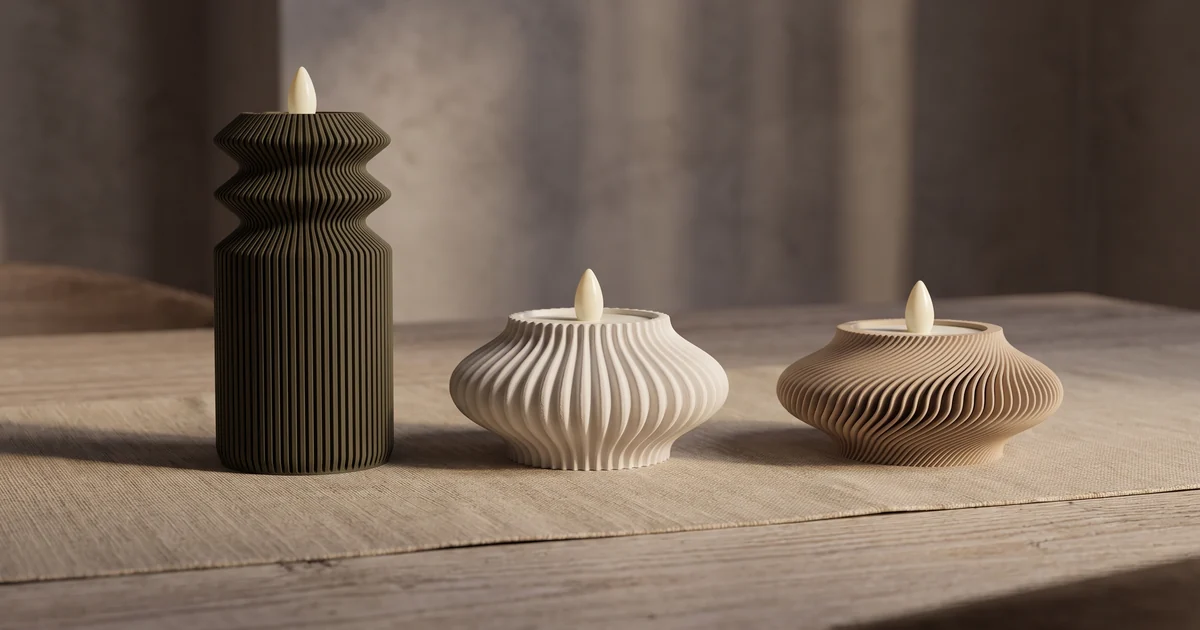
The Shiro (14 €) is the only tall format, Ø 4 cm by 14 cm, with pronounced vertical texture: it is the piece that structures a console or bedside table. The Ondéa (3 €) plays with undulating curves, in a more zen register. The Bubble (3 €) bets on rounded volumes and a bubble texture, more playful. The Lunar (4 €) remains the most minimalist, a circular disc with delicate relief. The Heart (3 €) embraces its symbolic shape and often goes as a gift. The Pumpkin (3 €), finally, comes out each autumn and lasts well beyond the evening of 31 October.
At 3 € per piece, it is also the most accessible entry point to the catalogue, and probably the best way to judge on the piece what a printed surface looks like before investing in a larger format.
Group, match, maintain
A single candle holder in the middle of a table rarely makes an impact. Two or three, of different heights, make much more: the Shiro for height, the Ondéa or Lunar for low points. This is the logic of odd-numbered composition, the same that applies to vases.
The second lever is colour. Our candle holders share their palette with vases and home accessories, which makes it possible to style an entire table in two close shades without ever hitting a tone gap. A beige and a marble sandstone, a khaki green and a wood: two values are enough.
For maintenance, nothing special, with one reservation: never heat. Damp cloth and mild soap, cold. No boiling water to unstick anything, no hair dryer, no dishwasher. The material that fears 55 °C in a living room fears it just as much in a sink.
Printed after your order
None of these six models exist in stock. The order arrives at the workshop, the spool of the chosen colour is mounted on a free machine, the piece prints, then it is deburred and checked by hand. Allow 5 to 7 days before dispatch, a timeframe that corresponds to actual manufacturing time and not a queue. The full process is described in an hour in the RE3DLINE workshop.
Frequently asked questions
- Can you put a real candle in a 3D-printed candle holder?
- No. Our candle holders are printed in PLA, a material that begins to soften around 55 to 60 °C, and every product sheet carries this warning. They are designed for an LED tea light. An open flame belongs in a glass or metal container, never in a printed piece.
- Why an LED tea light rather than a standard candle?
- Because a lit candle works its wax above its melting point and its aluminium cup transmits this heat to what holds it, which is exactly the zone where PLA deforms. An LED does not heat, does not flow and does not smoke: it can stay on without supervision, including in a bedroom.
- At what temperature does a PLA-printed object deform?
- Around 55 to 60 °C. The piece does not melt and does not catch fire: it softens and loses its geometry, an edge sags or a thin wall warps, and the defect remains after cooling. This is why PLA is an indoor material, to be kept away from heat sources.
- Will recycled PETG change anything for candle holders?
- Recycled PETG, which will join our ranges in the coming months, withstands a higher temperature, around 75 to 85 °C. It opens uses that PLA does not allow, outdoor use in particular. But it raises a thermal threshold without making a printed piece fire-resistant: a printed candle holder remains an LED object.
- How do you clean a 3D-printed candle holder?
- With a damp cloth and mild soap, cold. No boiling water, no hair dryer, no dishwasher: the heat that deforms the piece in a living room deforms it in a sink too. The colour is in the material and not painted on the surface, so it does not chip.
- How much does a 3D-printed candle holder cost and how long does it take to make?
- From 3 € for the Ondéa, Bubble, Heart and Pumpkin to 14 € for the Shiro, tall format of Ø 4 cm by 14 cm. Each piece is printed to order in our Guérande workshop, in the chosen colour, and dispatched within 5 to 7 days.