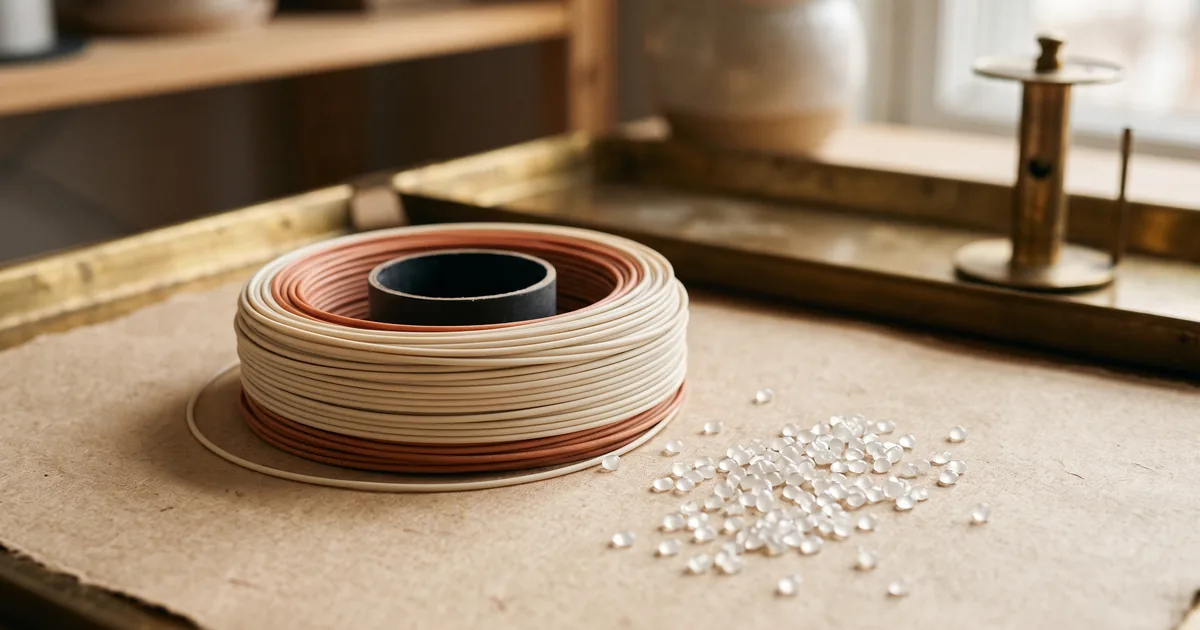
Is PLA really ecological?
Biosourced and low-energy, but compostable only in industrial facilities: the honest answer from a production workshop in Guérande, without greenwashing.
By L'atelier RE3DLINE
Yes and no. PLA is biosourced, derived from corn and sugar cane, and its production consumes approximately 65% less energy than an equivalent petrochemical plastic. But it is compostable only in industrial units, never in a garden. Its real ecological interest depends mainly on its end of life and on how it is produced.
"Biosourced" does not mean "impact-free"
PLA, or polylactic acid, is not derived from oil but from the fermentation of plant sugars, mainly corn starch and sugar cane. This is already a break from conventional plastics: the raw material is renewable and cultivated, not extracted from a fossil deposit.
That said, biosourced does not mean neutral. Agricultural cultivation, transformation into pellets then filament, transport: all of this has an energy and carbon cost. We detail this chemistry in our article on plant-based PLA. Honesty means saying that PLA starts from a much better position than a fossil plastic, without claiming it has no consequences.
Compostable, but not in your garden
This is the most common misunderstanding. PLA is compostable industrially: it requires heat above 60 °C, maintained in a professional composter in a controlled environment, to degrade in a few weeks. In a home compost heap, or worse abandoned in nature, it takes several years and does not disappear cleanly.
The practical consequence is simple: a PLA object is not a "disposable object that degrades on its own". It is an object you keep, reuse, and direct at end of life towards a recycling stream rather than towards your garden compost or the bin.
Energy, carbon and transport
On the energy front, PLA scores points: its production consumes approximately 65% less energy than that of an equivalent petrochemical PET, and its carbon footprint is significantly reduced. This benefit is all the more real when the filament is produced close to home.
We favour biosourced filaments from European manufacturers, which we transform in our workshop in Guérande. This short-circuit logic (European material, local manufacturing, no finished parts imported from the other side of the world) matters as much as the material itself in the final balance.
Where PLA reaches its limits
PLA has a real drawback: it softens from 55 to 60 °C. For a vase or an indoor flower pot, this makes no difference: these pieces will never experience such temperatures. But in direct sunlight behind glass, near a heat source, or for an outdoor piece exposed to the elements, PLA is not the right choice.
For these uses, the appropriate material is recycled PETG, made from plastic bottles: more resistant to heat and impacts, it holds up outdoors where PLA fails. We are integrating it into our workshop in the coming months. Choosing the right material for the right object is already an ecological decision: one that prevents a piece from warping and ending up in the bin.
Our position, without greenwashing
We will never claim that a 3D-printed object is "zero impact". What we can guarantee is a biosourced or recycled material, local manufacturing in a short supply chain, and a made to order model: we only print a piece when it is ordered. Result, zero overstock, zero unsold items discounted, zero production sent to the bin because a colour did not sell.
Our medium-term goal is to close the loop by recycling our own printing scraps internally. The technology exists; we are stabilising it at our scale. In the meantime, the honest answer to "is PLA ecological?" comes down to one sentence: it is a much better starting material than a fossil plastic, provided it is produced responsibly and not thrown into nature.
RE3DLINE workshop, Guérande
Frequently asked questions
- Is PLA biodegradable in my garden?
- No. PLA degrades in industrial composting (above 60 °C, in a controlled environment). In a home compost heap or in nature, it takes several years: it is better to keep it, reuse it or direct it towards a recycling stream.
- Is PLA really more ecological than conventional plastic?
- Its production consumes approximately 65% less energy than a petrochemical PET and it is biosourced (corn, sugar cane). But its real benefit depends on its end of life: reused or recycled, not thrown into nature.
- Does a PLA object resist heat?
- PLA softens around 55 to 60 °C. Avoid it therefore in direct sunlight behind glass or near a heat source. For these uses, the appropriate material is recycled PETG, more resistant, which will join our workshop in the coming months.
- Where is your PLA manufactured?
- We favour biosourced filaments from European manufacturers, transformed in our workshop in Guérande, to limit the carbon footprint related to transport.