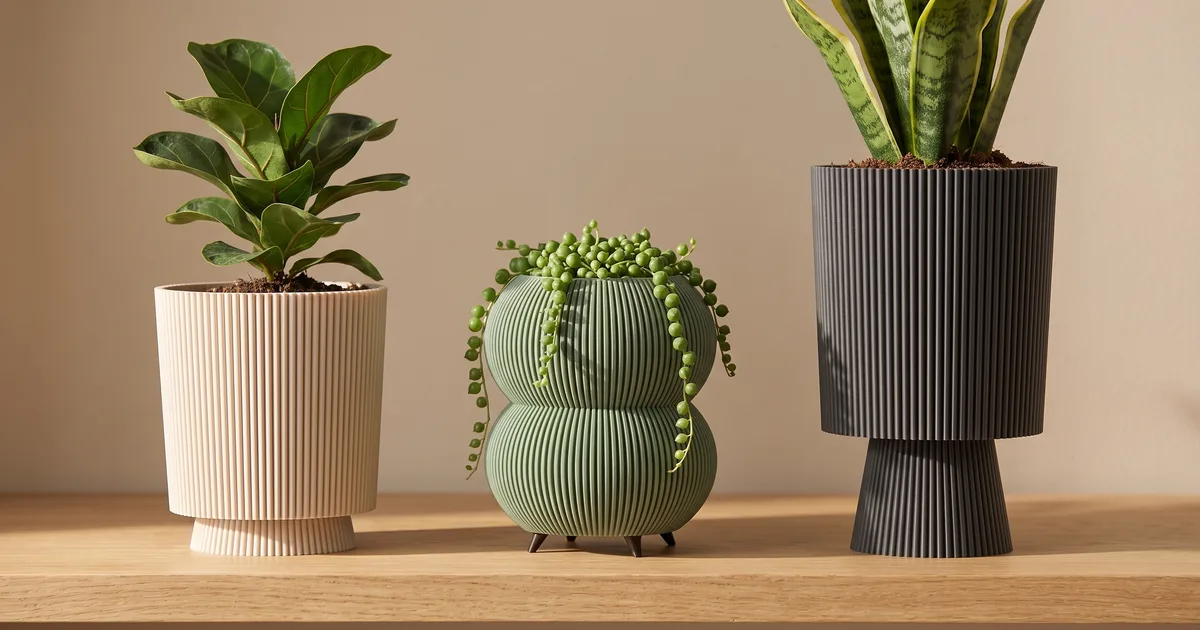
Cachepot or pot with drainage holes: which to choose for which plant
A pot with drainage holes on its saucer for a plant you'll keep for years, a cachepot for a plant that stays in its nursery pot. How to tell the two apart in our range, and which plants really need drainage.
By L'atelier RE3DLINE
A pot with drainage holes suits a plant you'll keep for years: water drains away, roots breathe. A cachepot suits a plant that stays in its nursery pot. We make both, and the underside photo in the product gallery tells you which you're looking at.
The difference comes down to a hole
A pot with drainage holes has one or more openings at the bottom. Watering water passes through the soil, exits through the base and falls into whatever sits beneath it, a stand or saucer, which you empty. The plant lives in it for years.
A cachepot is closed. It doesn't hold soil: it holds another pot, the flexible plastic nursery pot the plant arrived in from the garden centre. The cachepot dresses it up, it doesn't grow anything.
This difference isn't a vocabulary detail, it's what determines whether your plant stays healthy. Water pooling at the bottom of a closed container starves roots of oxygen and causes them to rot. It's by far the leading cause of death for indoor plants, ahead of forgotten watering and lack of light.
How to tell which one you're looking at
On our product pages, the gallery contains more than just the styled shot. For several models, it also includes a view of the underside or the pot laid on its side. That's the one to look at.
Three models clearly show their drainage holes: the Juno, the Minato and the Kaito. On the first two, the underside photo reveals seven holes arranged in a circle within a recessed disc, surrounded by a notched collar, and the stand positioned separately, detached from the pot. This stand isn't a flat saucer sitting underneath: it slots in under the base. On the Juno it's a narrow cone that raises the piece, on the Minato a low, wide stand with a shallow cup. On the Kaito, the overhead view shows the perforations at the bottom of the vessel, and the pot rests not on a stand but on three slim feet.
This two-piece construction is the key point. The pot and its stand aren't printed as one block: the stand detaches, which lets you empty it without lifting the plant and clean it when limescale deposits form.
Pots to plant directly into
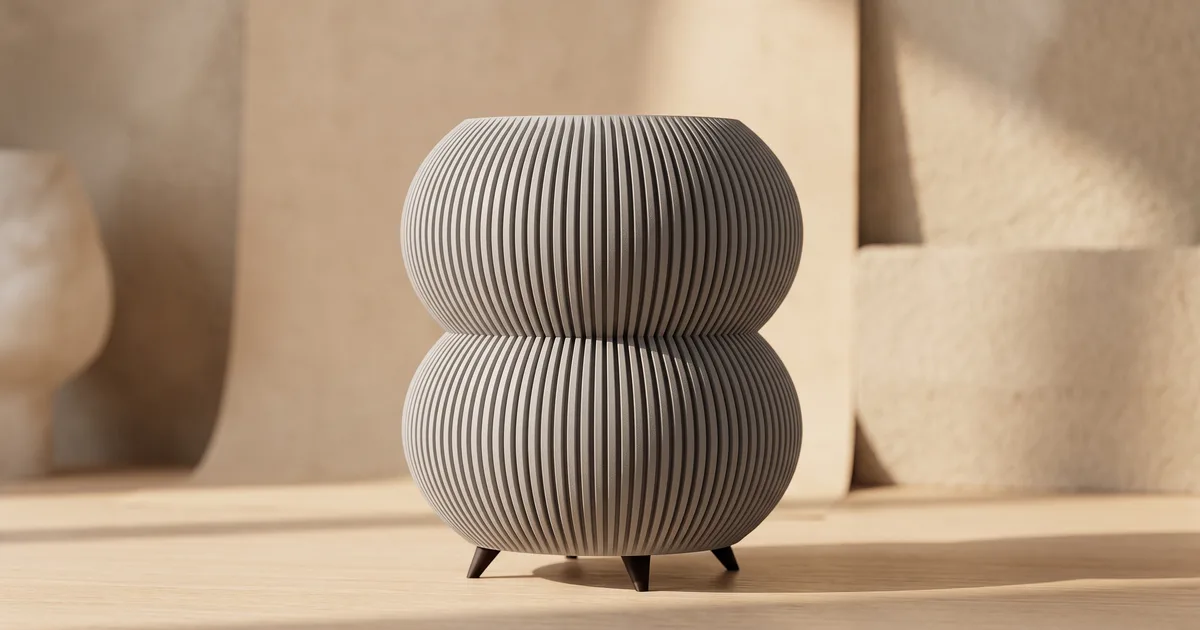
The Juno (£12) comes in 11 and 19 cm, a ribbed conical shape on its separate base. The Minato (£15) in 12 and 19 cm, a straight cylinder on stand. The Kaito (£28) in 15 and 22 cm, with its double bulge resting on three feet. These are the pieces to choose when the plant is there to stay: ficus, monstera, sansevieria, pilea, everything you keep and repot every two or three years.
Alongside them, the Riku (£9, 10 and 15 cm), the Negane (£8, 10 and 15 cm) and the Sora (£10, Ø9 and Ø13 cm) follow the same formal family, ribbed body and base or feet in a second colour. Their product pages don't include an underside view: if drainage is your deciding factor, go with the three models above, which are best documented, or ask us via the contact page before ordering.
The feet aren't just a style choice. A pot sitting flat on wooden furniture will eventually leave a ring, because moisture gets trapped between the two surfaces. A few centimetres of air underneath solves the problem. Be careful though: on a draining model mounted on feet like the Kaito, nothing catches the water that passes through. Water over the sink, or slip a saucer of your choice underneath.
The stand on the Juno and Minato, like the feet on the Kaito, are part of the product: they're printed with the pot, in the colour you choose for that area, and included in the stated price. It's not a separate accessory to order.
Double-walled cachepots
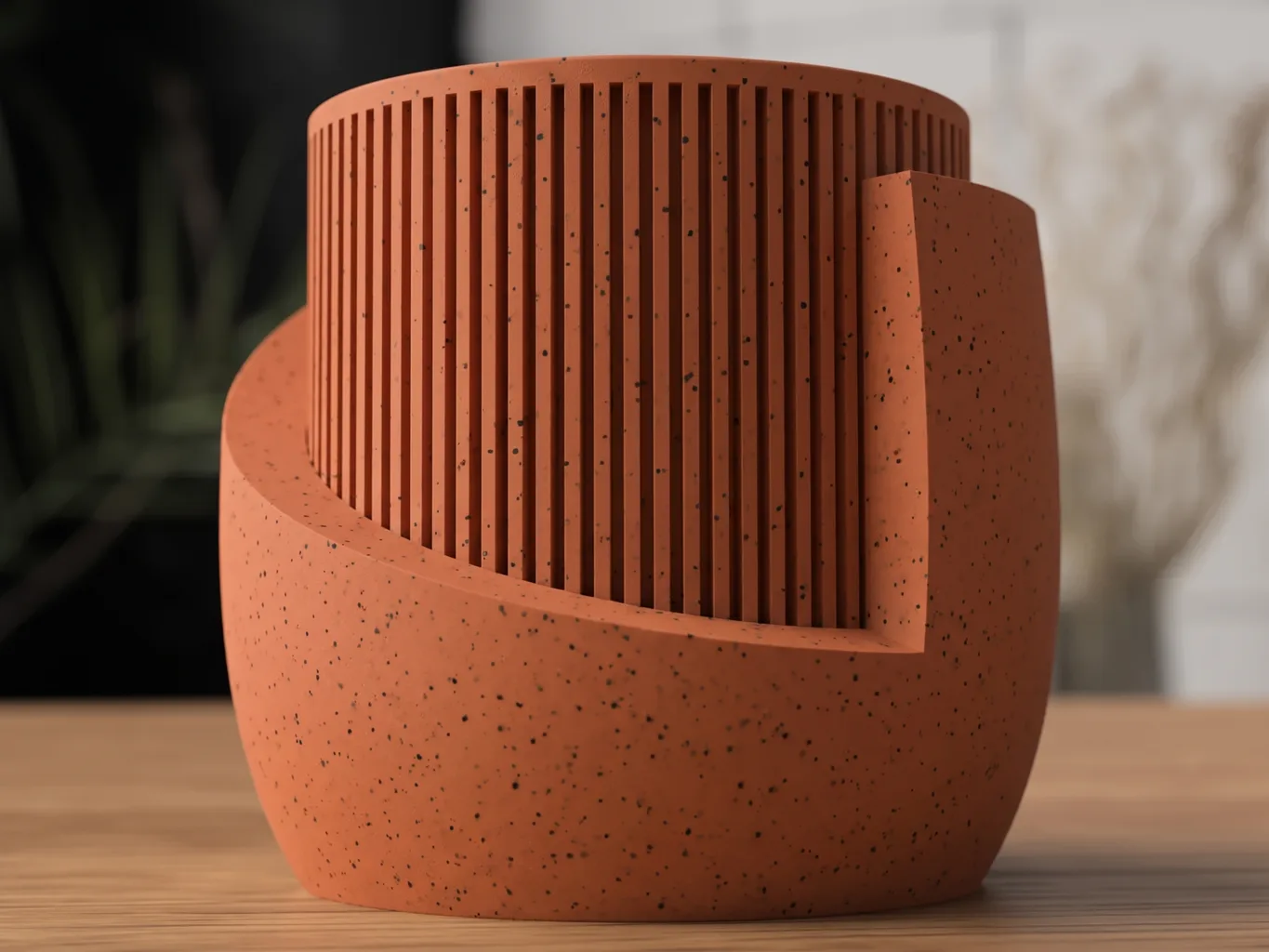
Two pieces in the range are designed from the start as cachepots, with an inner wall distinct from the visible outer envelope.
The Sekiya (£38, 15 cm) is a sculpture in two volumes: a fully open shell, spiralled, in which a ribbed cylinder sits. It's the most graphic piece in the catalogue, and the construction means the plant never touches the outer shell.
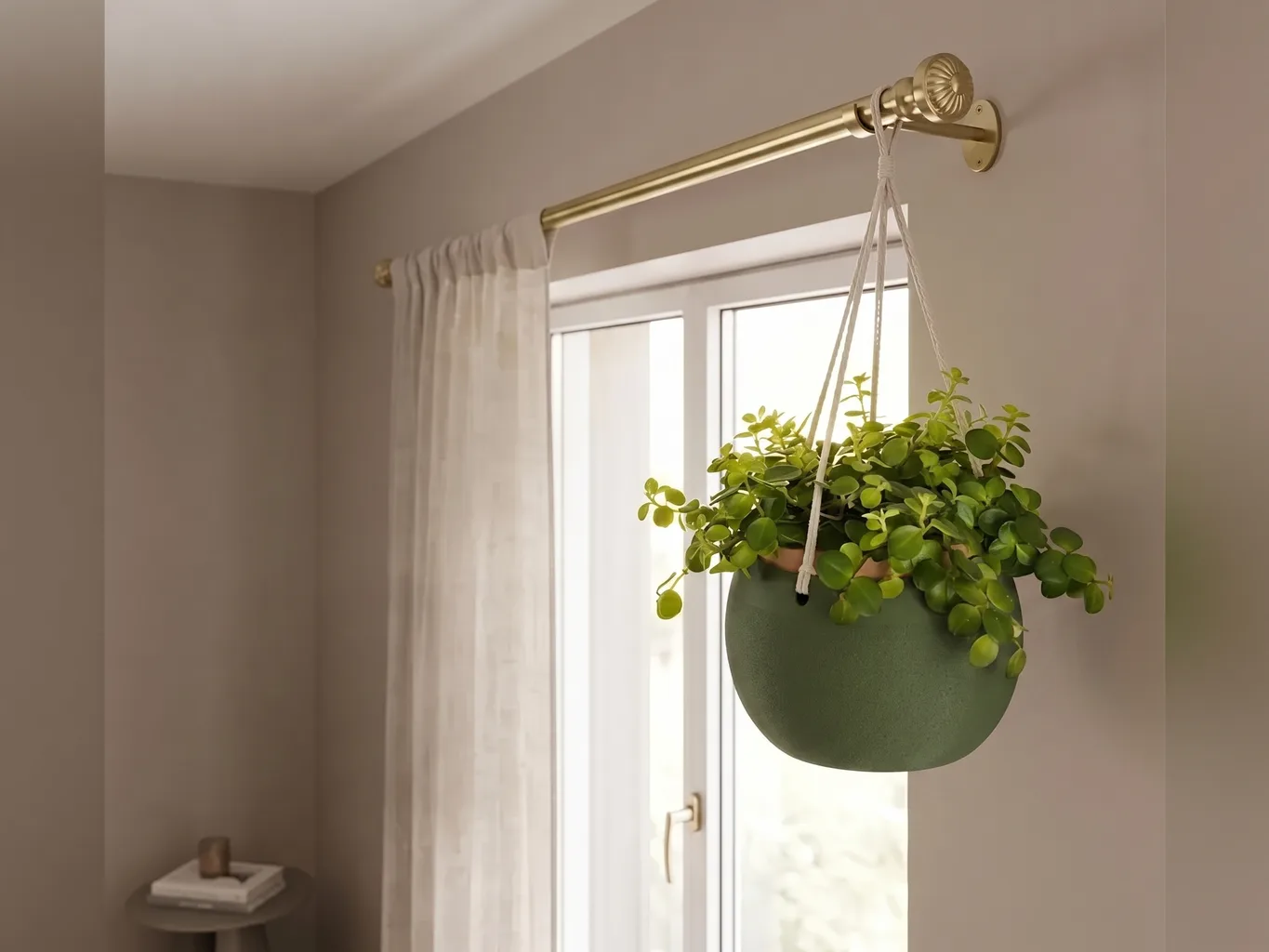
The Alto (£31, Ø 16 cm, height 10 cm) applies the same principle in suspension: a white sphere pierced with two passages for the cord, and a removable inner lining that holds the plant. This lining comes out, which lets you take the plant to the sink to water it without unhanging the suspension, a gesture anyone who's ever watered a hanging plant above a wooden floor will appreciate.
Planters, where the tray becomes the saucer
Third scenario: pieces where the base is a shared tray, not an individual stand.
The Mitsu (£39) is a set of three small ribbed pots aligned on a 31 cm oblong tray, all printed in two colours. The tray catches what drains and empties in one gesture. It's the format for windowsills and trios of cuttings.
The Daichi (£24, square 13.5 × 13.5 × 8.5 cm or rectangular 13.5 × 23 × 8.5 cm) and the Yora (£17, 20 × 12 × 13 cm) are low planters on feet, made for kitchen herbs and small plant compositions. The Kuro (£39, set of 3, Ø9 cm, height 12 cm) mounts on the wall, where no other surface is left.
Which plants really need a pot with drainage holes
The rule comes down to how well the plant tolerates standing water.
Drainage holes essential for anything that comes from dry climates: cacti, succulents, sansevieria, zamioculcas, aloe. These plants accept dryness for weeks and won't forgive a single week with wet feet. Same goes for indoor plants you plan to keep long term, monstera, ficus, philodendron: over several years, a closed container will eventually cause problems.
Cachepot possible when the plant won't stay long, or when it already lives in a suitable container. An orchid is sold in a clear draining pot that serves its photosynthetic roots: it must stay there, and the cachepot just hides the plastic. A seasonal flowering plant, a bunch of hyacinths, a Christmas arrangement lives for a few weeks and won't notice the difference. Herbs bought in a tray and used within the month, same thing.
Cuttings are a special case: they live in water, so in a deliberately sealed container. We have two pieces made for that, the Ringia (£17, set of 2) and the Quartis (£11, tubes included), where the cutting roots in a glass tube.
Size choice, on the other hand, doesn't depend on drainage but on the plant's spread. We've detailed it model by model in which design flower pot for which plant, worth reading alongside this one.
The double-pot method, when you're unsure
There's a solution that works in every case, even with a closed container: keep the nursery pot and use it as an inner pot.
You take out the nursery pot, water over the sink, let it drain for five minutes, put it back. No water pools, and you see the state of the roots at every watering, which is the best free diagnosis there is. The downside is aesthetic: the nursery pot needs to sit low enough to disappear, so plan for a container a bit taller than it is wide.
If you plant directly into a draining pot, the reverse applies: lay a thin layer of clay pellets at the bottom, no more than two centimetres, and detach the stand to empty it twenty minutes after watering. A stand that stays full all the time cancels out the benefit of the holes.
The right diameter: the two centimetre rule
For a cachepot, measure the diameter of the nursery pot at the rim, not the width of the foliage, and add two to three centimetres. A 12 cm nursery pot fits into a 15 cm container without forcing and without rattling.
For direct repotting, the rule is the same but for a different reason: a pot much too large holds a volume of soil the roots don't colonise, that soil stays wet, and you're back to the problem the holes were meant to solve. You go up one size at a time.
Colours, material, and what recycled PETG will change
All these models share the same around twenty colours, mostly matte, with a few marbled finishes and a wood finish. The two-tone pots let you choose the body and base or feet separately, with no price change: a beige body on a terracotta base, or a complete tone-on-tone.
The material is biosourced PLA, a bioplastic made from maize starch. Indoors, it's stable and handles soil moisture very well. Outdoors, the limiting factor isn't rain but prolonged direct sun, which eventually marks the material: a north-facing balcony or covered terrace, yes; full south sun in August, no. Recycled PETG, more tolerant, will join our ranges in the coming months and will genuinely open up outdoor use; the comparison of the two materials is in PLA or PETG, which material for which décor object.
For maintenance, a damp cloth and mild soap, cold water. The colour is in the material itself, not painted on the surface, so it won't chip.
Printed after your order
None of these pieces are in stock. Your order arrives at our workshop in Guérande, the spools of your chosen colours are loaded onto an available machine, the piece and its base print, then the whole thing is deburred and checked before packing. Allow 5 to 7 days before dispatch.
Browse the full range on the flower pots page, how the workshop works is told in an hour in the RE3DLINE workshop, and bulk pricing for outfitting a hall, restaurant or shop is on our professionals page.
Frequently asked questions
- What is the difference between a cachepot and a pot with drainage holes?
- A pot with drainage holes has openings at the base: water passes through the soil and drains into the stand or saucer placed underneath, which you empty, and the plant lives in it for years. A cachepot is closed and doesn't hold soil: it dresses up the nursery pot the plant arrived in. Standing water at the bottom of a closed container is the leading cause of root rot.
- How do I know if a RE3DLINE pot has drainage holes?
- By looking at the product page gallery. The Juno and Minato have an underside photo showing seven holes in a recessed disc, with their stand detached and positioned separately; the Kaito has an overhead view showing the perforations at the base of the vessel. For other models, you can ask us via the contact page before ordering.
- Which plants really need a pot with drainage holes?
- Anything that comes from dry climates: cacti, succulents, sansevieria, zamioculcas, aloe. And any indoor plant you plan to keep for several years, monstera, ficus, philodendron. Conversely, an orchid stays in its clear pot, and a seasonal flowering plant or herbs used within the month will do fine in a cachepot.
- What size cachepot for a given nursery pot?
- Measure the diameter of the nursery pot at the rim, not the spread of the foliage, and add two to three centimetres. A 12 cm nursery pot fits without forcing into a 15 cm container. For direct repotting, go up one size at a time: too large, and unconolonised soil stays wet.
- Why do our pots have feet or a separate stand?
- The stand on the Juno and Minato isn't a flat saucer sitting underneath: it slots in under the pot base and detaches, letting you empty it without lifting the plant. The feet lift the base off the furniture: a pot sitting flat on wood will eventually leave a ring. On a draining model with feet like the Kaito, nothing catches the water, so water over the sink.
- Can a 3D printed pot stay outside?
- The limiting factor isn't rain but prolonged direct sun, which eventually marks the PLA. A north-facing balcony or covered terrace is fine, full south sun in August is not. Recycled PETG, more tolerant, will join our ranges in the coming months.