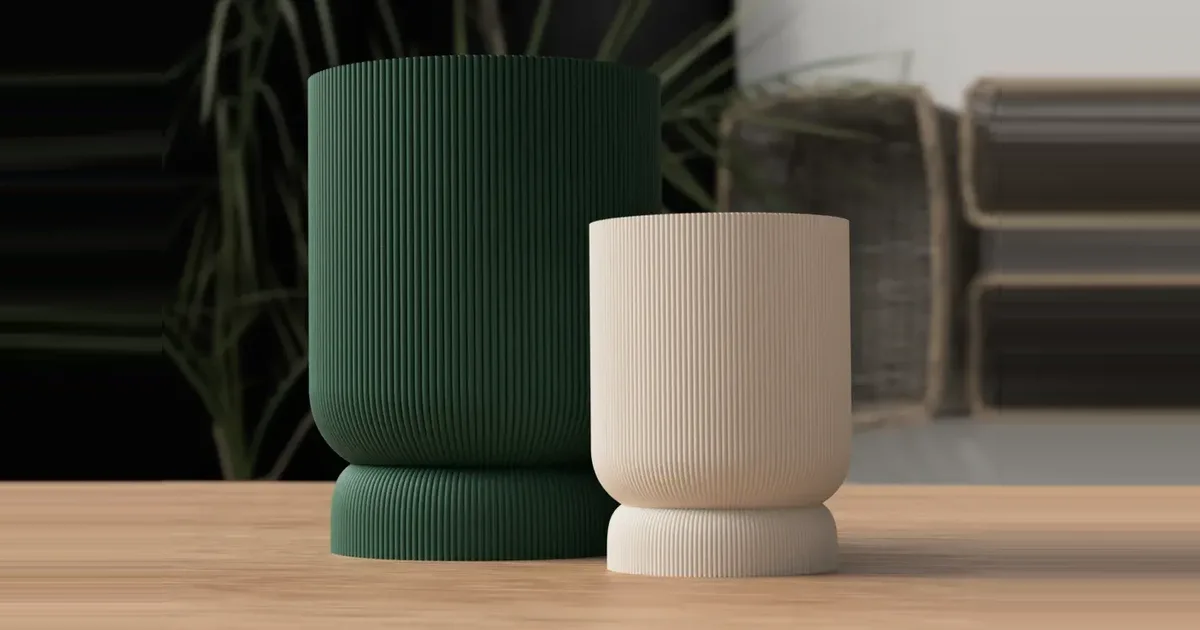
Which design plant pot for which plant?
A pot is chosen by the diameter of the growing pot, not by the shape of the plant. A guide by size across our seventeen models printed in Guérande, from the succulent at Ø9 cm to the 71 cm plant column.
By L'atelier RE3DLINE
A plant pot is chosen by the diameter of the growing pot, not by the shape of the plant. Allow one to two centimetres of clearance around it, check the height, and let style decide afterwards. Our seventeen models cover everything from the succulent at Ø9 cm to the 71 cm plant column.
The only measurement that matters at the start
The plant you have just bought already lives in a container: the growing pot in soft plastic, black or terracotta, with holes at the bottom. It is this container, and this alone, that must fit into your new pot. Its size is written on it or on the label, as a diameter: 9, 11, 12, 15, 19, 22 cm.
Note this figure, add one to two centimetres, and you have your size. A growing pot of 11 cm fits into a pot of 12 or 13 cm: enough clearance to remove and replace it without forcing, little enough that it does not move about. Beyond three centimetres difference, the plant floats and the whole thing loses its balance.
Height is checked the same way. The ideal is for the rim of the growing pot to reach just below the rim of your pot, or slightly below: the foliage then appears to emerge from the pot itself. This detail, more than the shape or colour, makes the difference between a plant placed in a container and a plant that looks at home.
Only then comes style, and that is where the choice becomes enjoyable.
Succulents, cacti and small plants: Ø9 to Ø12
This is the most common size, for plants you place on a desk, a windowsill or a bedside table. Four models cover this range, in four different styles.
The Sora (from £10) comes in Ø9 cm at 5.5 cm high and Ø13 cm at 8.5 cm. Its ribbed relief and visible feet give lightness to a piece that remains small. The Riku (£9) plays the same card of a footed pot in 10 and 15 cm. The Negane (£8), also in 10 and 15 cm, is the most understated in the catalogue and the most accessible entry point to the collection. The Juno (£12), finally, offers an 11 cm and a 19 cm, with a sharper and more contemporary cut.
For a succulent or cactus, choose the smallest size without hesitation. These plants have a modest root system and a pot that is too large works against them both visually and practically.
Established indoor plants: Ø15 to Ø22
Above 15 cm, you move beyond a supplementary piece to a plant that occupies a place in the room: a pilea that has grown well, a calathea, a young monstera, a ficus in a 19 cm pot.
The Kaito (£28) goes up to 22 cm and takes on a more sculptural form, best reserved for plants with generous foliage that balance its volume. The Minato (£15) covers 12 and 19 cm with a denser texture, very much at home in dark green tones. The Sekiya (£38), in 15 cm as a single size, is the only asymmetrical model in the range: its vertical lines and angled cut make it a piece you place alone, not in the middle of a row.
At these sizes, think about weight once the plant is in place. Moist soil in a 19 cm pot weighs several kilos, and it is the furniture that must support it, not the pot: our pieces handle this without issue, as we explain in is a 3D printed object really solid and durable.
Tall plants that need support
Monstera, climbing philodendron, pothos spreading in all directions: these plants need a stake, and the bamboo stake planted in the soil rarely stays discreet.
The Stemra (£26) solves this differently: its stakes are integrated into the pot, drawn in the same ribbed pattern and printed in the same colour. It comes in pot sizes 11, 13 and 15 cm, with an additional module when the plant grows taller. The whole thing remains coherent instead of becoming a makeshift arrangement.
For a more ambitious vertical composition, the Moss Budy (£14) is a modular column: 46 cm in one tier, 71 cm in two tiers. It is the tallest piece in the collection, designed to occupy a room corner without taking up floor space.
Herbs, kitchen and small compositions
Basil, chives and mint arrive in pots of 9 to 12 cm and tend to sit in their original packaging on a work surface. Two planter formats address this.
The Daichi (£24) comes in a square of 13.5 x 13.5 x 8.5 cm and a rectangular of 13.5 x 23 x 8.5 cm: the latter aligns two to three herb pots without crowding them. The Yora (£17), at 20 x 12 x 13 cm, plays a taller register and suits both a small composition and a single well-nourished plant.
A practical note, valid in all kitchens: keep these pieces away from hobs and ovens. The PLA they are printed in begins to soften around 55 to 60 degrees Celsius, a temperature a work surface can reach faster than you might think.
Freeing up surface: hanging or wall-mounted
When surface is scarce, the plant goes up. Three pieces address this, each in its own way.
The Alto (£31), Ø16 cm at 10 cm high, is designed to be hung and is intended for trailing plants, pothos, ceropegia, string of hearts. It is sold without cord, deliberately: the cordage is part of your decor, not ours, and natural cotton or fine leather tell different stories. The Hangis (£25), 12 x 15 x 24 cm, takes the opposite approach with an integrated handle printed in one piece: it hangs, but sits just as well on a console or in an entrance.
The Kuro (£39) goes on the wall: a set of three pots at Ø9 cm and 12 cm high, to arrange in a vertical composition or in a line. Three small plants hung have more impact than one large one placed on the floor, and the wall costs nothing in surface.
One stem, one cutting, three pots
There remain the supplementary sizes, those you do not anticipate and which end up being the most used.
The Quartis (£11), 6.5 x 21 x 4 cm, lines up four transparent tubes supplied with the piece: this is the propagation support, the one that makes presentable the phase when a stem waits for its roots in a mustard jar. The Ringia (£17, set of two) goes even smaller: two sculptural pieces of 3.5 x 11 x 14 cm for a single stem. The Mitsu (£39, set of three) brings together three ribbed containers on a shared base of 31 cm: placed on a table or console, it serves as a plant centrepiece.
These three models drift into the territory of vases, with which they share the palette. If you are instead looking to showcase cut or dried flowers, our guide to vases by flower type takes over.
Watering without damaging the piece
The simplest method is also the best for the plant: keep the growing pot inside the printed pot and use the latter as a cache-pot. You remove the growing pot to water it, you let the water drain for a few minutes in the sink, then you put it back in place. No water stagnates at the bottom, which remains the leading cause of root rot, regardless of pot material. Several of our models are however perforated at the bottom and supplied with their saucer, which allows you to plant directly in them: we explain how to tell them apart and which of the two methods suits which plant in cache-pot or perforated pot: which to choose for which plant.
For maintaining the piece itself, a damp cloth and mild soap are enough, used cold. No dishwasher, no boiling water: the same temperature limit that applies on a work surface applies in a sink. The colour is in the material itself and not painted on the surface, so it does not chip and is refreshed by a simple wipe with a cloth.
Indoors, outdoors, and what recycled PETG will change
All our pots are currently printed in biosourced PLA, a bioplastic of plant origin derived from maize starch. Indoors, it performs very well and does not move.
Outdoors, the limiting factor is not rain but prolonged exposure to direct sunlight, which eventually marks the material. A north-facing balcony, a covered terrace or the base of a shaded wall are suitable; full south in high summer, no. We have detailed what holds up outdoors and what is better kept sheltered in our article on summer terrace decor.
Recycled PETG, which handles higher temperatures and tolerates temperature swings better, will join our ranges in the coming months and will genuinely open up the outdoors. The comparison of the two materials, without commercial shortcuts, is in PLA or PETG, which material for which decor object. And on the ecological question, which the word biosourced does not settle, we answer with figures in is PLA really ecological.
Printed after your order, in the colour you choose
None of these seventeen models exists in stock. Your order arrives at the Guérande workshop, the spool of the chosen colour is mounted on a free machine, the piece prints, then it is deburred and checked by hand before packing. Allow 5 to 7 days before dispatch: this is the actual manufacturing time, not a queue.
Concretely, this means that a Ø13 pot in khaki green does not depend on what a warehouse chose to order in khaki green six months earlier. The around twenty colours are available across the entire range, and you can hold an entire piece in two close shades by mixing shapes. The full operation of the workshop is told in an hour in the RE3DLINE workshop, and the entire range can be browsed on the plant pots page.
Frequently asked questions
- What size pot should I choose for my plant?
- Measure the diameter of the plastic growing pot in which the plant is sold, then add one to two centimetres. A growing pot of 11 cm fits into a pot of 12 or 13 cm. Beyond three centimetres difference, the plant floats and the whole thing loses its balance.
- Should I repot the plant directly into a 3D printed pot?
- The simplest approach is to keep the growing pot and use the printed piece as a cache-pot: you remove it to water, you let it drain, you put it back in place. No water stagnates at the bottom, which remains the leading cause of root rot.
- Which pot should I choose for a trailing or hanging plant?
- The Alto, Ø16 cm at 10 cm high, is designed to be hung and suits trailing plants like pothos or string of hearts. It is sold without cord, to be chosen according to your decor. The Hangis, with its integrated handle, can be hung or placed. The Kuro, a set of three Ø9 cm pots, goes on the wall.
- Which pot for a tall plant that needs a stake?
- The Stemra integrates its stakes into the pot, drawn in the same ribbed pattern and printed in the same colour, in pot sizes 11, 13 and 15 cm with an additional module for plants that grow taller. For a more ambitious vertical composition, the Moss Budy is a modular column of 46 cm in one tier and 71 cm in two tiers.
- Can a 3D printed plant pot stay outdoors?
- Yes, on a sheltered balcony, a covered terrace or at the base of a shaded wall. The limiting factor is not rain but prolonged exposure to direct sunlight, which eventually marks the PLA. Recycled PETG, which handles heat and temperature swings better, will join our ranges in the coming months.
- How much does a 3D printed plant pot cost and how long does it take to make?
- From £8 for the Negane to £39 for sets of three Kuro and Mitsu. Each piece is printed after order at our Guérande workshop, in the colour you choose from around twenty options, and dispatched within 5 to 7 days. Nothing is produced in advance.