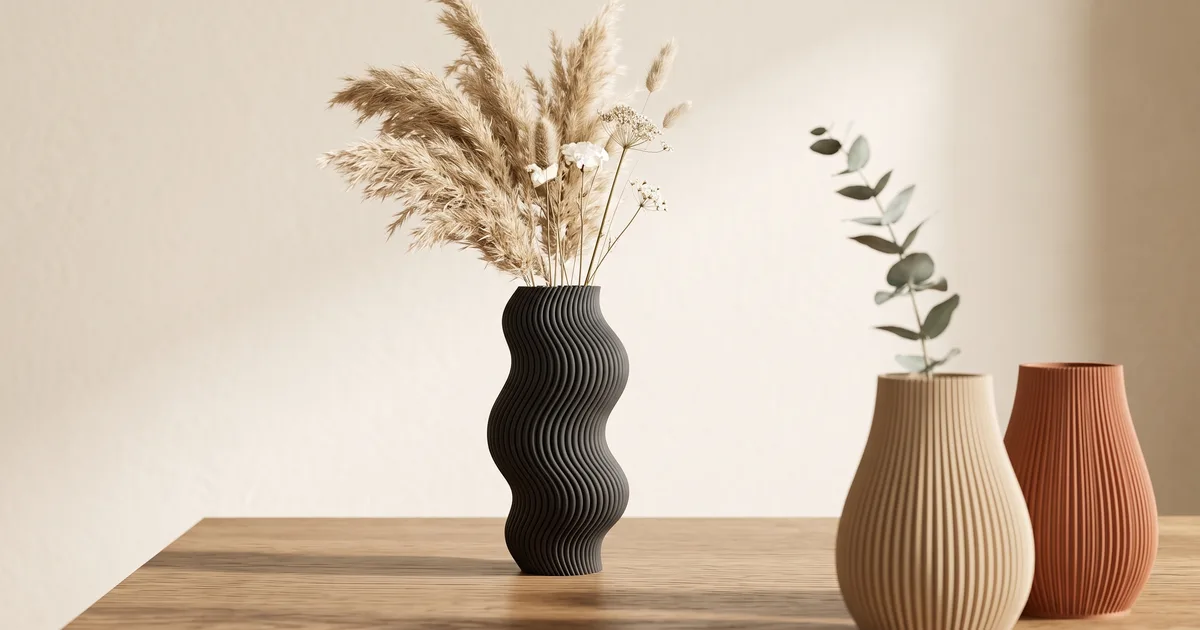
How to choose a decorative vase for your flowers
Round bouquet, tall stems, pampas grass, single flower or dried flowers: each arrangement calls for a specific vase shape. Our Guérande workshop guide, model by model, so you never get it wrong.
By L'atelier RE3DLINE
A beautiful vase chosen poorly undermines the bouquet, and vice versa. The workshop rule comes down to three questions: what stem length, what volume of flowers, fresh or dried? The answer determines the vase height, the width of its neck and its stability. Here's how to match each arrangement to the right model.
The two-thirds rule, the only ratio to remember
Florists work with a simple reference point: flowers should extend above the vase by roughly one and a half times its height. In other words, the vase represents one third of the total height of the arrangement, with flowers making up the remaining two thirds. A bouquet with 40 cm stems therefore calls for a vase of 15 to 20 cm; longer stems are trimmed to recover this ratio, we'll come back to that below.
This ratio is not a law, it's a starting point. You can deliberately break it for a specific effect: stems cut very short flush with the neck for a dome effect, or a single oversized stem in a bud vase. But when a bouquet "doesn't work", it's almost always this proportion that's the culprit.
Round bouquet: generous belly, tapered neck
The florist's round bouquet, peonies, roses, ranunculus, is composed to be held in hand. To keep its shape in the vase, you need a belly that lets the stems spread in a spiral and a neck that holds them grouped together. That's exactly the silhouette of our Luna, with organic curves, or the Nami and its undulations inspired by water movement.
Simple visual guide: once the bouquet is in place, the stems should touch the neck walls without forcing. Too much space, they collapse over the edges; too tight, the bouquet strangles and the centre flowers suffocate. If you're unsure between two models for a specific bouquet, ask us for exact dimensions: we have them all on hand.
Tall stems and pampas grass: stability above all
Pampas grass, eucalyptus, willow or olive branches: these tall arrangements, very much in vogue, come in stems of 60 to 90 cm. The danger isn't aesthetic, it's physical: pampas plumes offer real wind resistance, and a lightweight vase with a narrow base ends up on the floor at the first breeze.
Two solutions: a wide base, and trimmed stems. Pampas grass cuts without hesitation, it's even the secret of florist arrangements: trimmed to 50 or 60 cm, it keeps all its volume and stops playing the role of a sail. Our largest formats, around 23 to 24 cm, are dimensioned for this balance: our Tama, sculptural silhouette with vertical relief, plays the statement piece on a low cabinet or console, and the Neki, more slender, serves the same purpose.
A single flower: the bud vase embraces minimalism
A tulip, a cherry blossom branch, a sprig of baby's breath: the simplest arrangement is also the most demanding, because the vase does half the work. A narrow neck that holds the stem upright, a graphic silhouette that stands on its own on flowerless days: that's the register of the Shinto and Shizu, our two compact formats with Japanese inspiration.
The bud vase is also the best entry point into a collection: placed two or three at different heights, it creates a shelf scene that evolves through the seasons.
Dried or fresh flowers: the water question
Our vases are printed in biosourced PLA, a plant-based material whose true environmental impact we've detailed here. With dried and stabilised flowers, pampas grass, lagurus, statice, everlasting flowers, they're used without any constraints: no water, no maintenance, an arrangement that lasts for years.
For fresh flowers, our vases receive a waterproofing treatment at the workshop: a technical resin impregnates the printed walls and makes them water-tight, without changing the surface appearance. The vase then works like a classic vase, water included. If you're unsure about a specific model, ask us: we're the ones who printed and treated it.
Colour, the final decision (and the simplest)
Each model in our vase collection comes in around twenty colours, from white to black via sand and terracotta. The short rule: colourful flowers on neutral vase (white, sand, grey), foliage and dried flowers on a characterful vase (terracotta, black). Since everything is made to order in our Guérande workshop, in 5 to 7 days, colour is chosen at no extra cost and without stock constraints. And if the piece is to live on the terrace, we'll explain which material holds up outdoors.
RE3DLINE workshop, Guérande
Frequently asked questions
- What vase size for which bouquet?
- Apply the two-thirds rule: flowers should extend above the vase by roughly one and a half times its height. A bouquet of 40 cm stems suits a vase of 15 to 20 cm; for very long stems (pampas, eucalyptus), trim them to 50-60 cm and choose a vase of 20 cm or more, with a stable base.
- What vase for a florist's round bouquet?
- A vase with a generous belly and tapered neck: the belly lets the stems open like a fan, the neck holds them grouped together. It's the most versatile shape if you only own one vase.
- Can you put fresh flowers in a 3D printed vase?
- Yes: our vases receive a waterproofing treatment at the workshop that impregnates the walls and makes them water-tight. They work with fresh flowers just like a classic vase, and of course without any constraints with dried and stabilised flowers.
- What vase for pampas grass?
- Pampas grass comes in stems of 60 to 90 cm and needs no water. Trim the stems to 50-60 cm and choose a vase with a wide base to counter the wind resistance of the plumes. A sculptural model like our Tama or Neki does the job without tipping over.