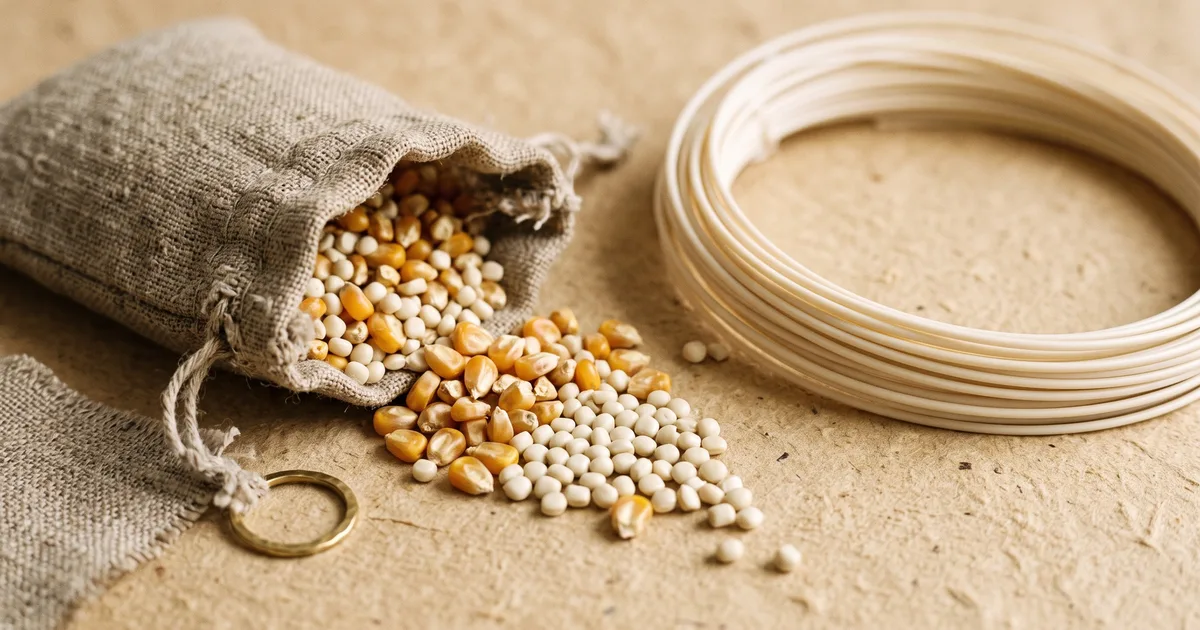
From corn to filament: where our PLA comes from
Fermentation of plant sugars, granules, extrusion into filament: the PLA in our pieces starts in a cornfield or sugarcane plantation. The complete journey of the material, from plant to the object on your shelf.
By L'atelier RE3DLINE
PLA, or polylactic acid, is a polymer made from plant-based resources, primarily corn and sugarcane. Sugars are fermented into lactic acid, polymerised into granules, then extruded into filament. This is the material that makes up our entire catalogue today, printed in our Guérande workshop.
Step 1: from field to sugar
It all starts with a plant rich in starch or sugar: usually corn, sometimes sugarcane, depending on the supply chain. The starch is extracted and then hydrolysed into simple sugars. Nothing exotic at this stage: it's the same basic chemistry as the food industry.
Step 2: fermentation, like yoghurt
These sugars are then fermented by micro-organisms that transform them into lactic acid, exactly the molecule that gives yoghurt its acidity. This is what fundamentally distinguishes PLA from petrochemical plastics: its basic building block comes from fermentation, not a barrel. Published life cycle analyses estimate that its production consumes approximately 65% less energy than that of an equivalent petroleum-based plastic.
Step 3: from granule to filament
The lactic acid is polymerised into long chains, polylactic acid, packaged in the form of small ivory granules. These granules are melted, tinted and extruded into a calibrated 1.75 mm diameter wire, wound onto spools: 3D printing filament. We source our spools from European manufacturers wherever possible, in a palette of around twenty colors that you'll find on our pieces.
Step 4: printing, at our workshop
The final transformation takes place in our Guérande workshop: the filament is melted layer by layer to become a vase, a statue or a pot. Made to order in 5 to 7 days, hand-finished, quality checked before packaging. From field to your shelf, the chain is short and transparent, and that's exactly what we love about this material.
What PLA can do, and what it cannot
PLA requires great precision in deposition and a matte finish that serves our vases as well as our pots. Its limitations are well known: it begins to soften between 55 and 60°C, which restricts it to indoor use. For outdoor applications, the reference material will be recycled PETG, which will join the workshop in the coming months; we've written a complete guide to choosing between the two: PLA or PETG, which material for which decorative object?
As for end of life, PLA is industrially compostable (above 60°C in a controlled environment), but not in a home compost heap. Does that make it an ecological material? The question deserves more than a slogan, and we've answered it without spin: is PLA really ecological?
RE3DLINE workshop, Guérande
Sources
The data cited in this article is based on public references:
Vink E.T.H. et al., "Applications of life cycle assessment to NatureWorks polylactide (PLA) production", Polymer Degradation and Stability, vol. 80, 2003: sciencedirect.com
Prusa Research, comparative table of 3D printing materials (PLA and PETG deflection temperatures): help.prusa3d.com
Frequently asked questions
- What is PLA made from?
- PLA, or polylactic acid, is a polymer obtained by fermentation of plant sugars, primarily from corn and sugarcane. The sugars are transformed into lactic acid, then polymerised into granules, which are themselves extruded into 3D printing filament.
- Does PLA contain petroleum?
- The polymer itself is plant-based, obtained by fermentation of sugars, unlike conventional petrochemical plastics. Its production consumes approximately 65% less energy than that of an equivalent petroleum-based plastic, according to published life cycle analyses on the subject.
- Is PLA compostable?
- Only under industrial conditions: it requires sustained heat above 60°C in a controlled environment to degrade. In a home compost heap or in nature, it takes several years. A decorative PLA object isn't meant to be thrown away anyway: it's made to last.
- Where is the filament for your pieces processed?
- We source our spools from European manufacturers wherever possible, to limit the environmental impact of transport. Printing, finishing and quality control are then carried out entirely in our Guérande workshop in Loire-Atlantique.