Desk storage: 5 design accessories for back to school
A well-organised desk comes down to four objects: a pencil pot, a phone stand, a headphone stand and a catchall tray. Five pieces 3D-printed in Guérande, from 4 to 34 €, with their actual dimensions and how to coordinate them.
By L'atelier RE3DLINE
A well-organised desk comes down to four objects: a pencil pot, a phone stand, a headphone stand and a catchall tray. Everything else goes in a drawer. Our desk accessories are 3D-printed in Guérande in around twenty colors, from 4 to 34 €, and shipped within 5 to 7 days.
Back to school starts with the work surface
You don't organise a desk by buying another box. You organise it by deciding what stays on top. In practice, what clutters a work surface is always the same short list: pens that roll, a phone lying flat taking up the space of a notepad, headphones placed anywhere, keys and loose change, glasses you can't find.
Four objects on the work surface and one on the wall solve these five problems. They share the trait of being small, handled every day, and constantly visible: which is why their design matters as much as their function. An ugly desk organiser ends up in a drawer, and the mess returns.
Here are the five pieces we print for this purpose, four to place and one to fix to the wall, with their actual dimensions and what they really do.
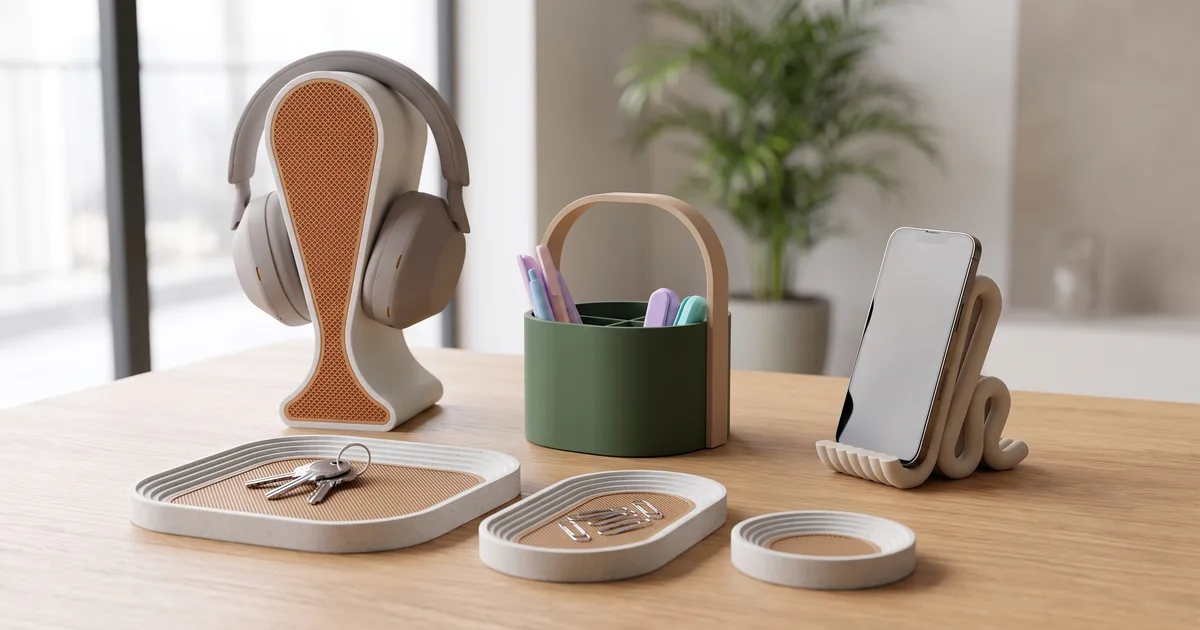
1. The moveable pencil pot: Tandis
The Tandis (18 €) is a pencil pot measuring 15 × 15 × 9 cm, 18 cm tall with its handle. The interior is divided into four compartments by two crossed partitions: pens on one side, markers on the other, scissors and craft knife at the bottom, highlighters in the last quarter. You find what you're looking for without spilling everything.
The handle is the real design choice of this model. A pencil pot moves more often than you'd think: from the desk to the living room table in the evening, from the bedroom to the kitchen for homework, from the workshop to the garden. The handle lets you pick it up with one hand without anything falling. It's also what makes it as much a child's bedroom piece as a desk accessory.
The body and handle are printed in two colors, chosen separately from around twenty available: a khaki green body with a beige handle, a matte black body with a wood handle, or a single tone if you prefer subtlety.
2. The 4 € phone stand that frees up your work surface
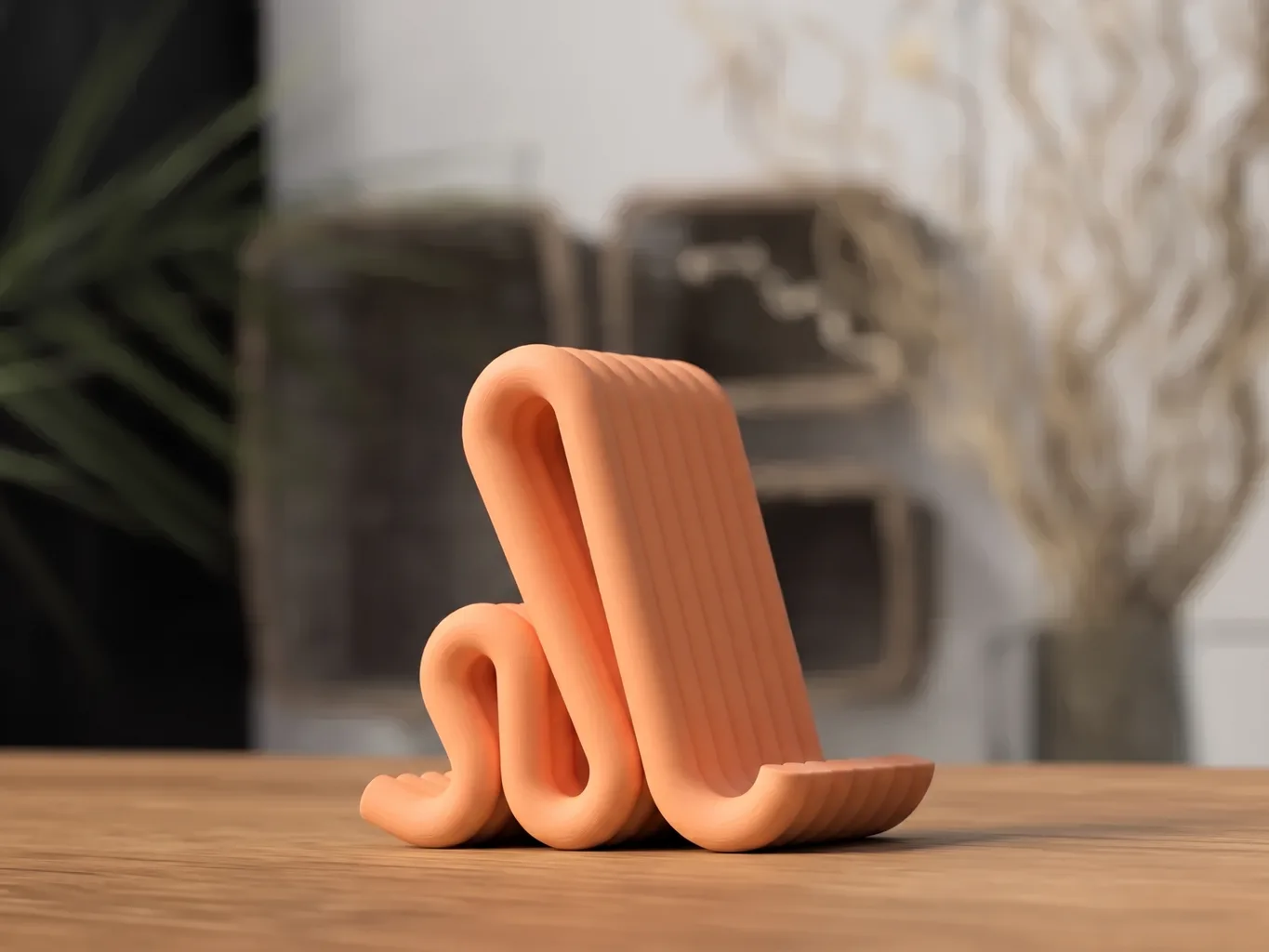
Lying flat, a smartphone takes up the space of a notepad and, worse, it gets forgotten until it vibrates under a pile of papers. Stood upright, it becomes readable at a glance and gives back space to your work surface.
The phone stand (4 €) is a ribbed ribbon folded back on itself, all in one piece, with no hinge or added parts. The device rests in the loop, stood upright at eye level. It's the cheapest piece in our catalogue, and the one you end up ordering in three copies: desk, kitchen, bedside table.
Its loop design stands up through its geometry, not its weight. We explain what shape brings to the strength of a 3D-printed piece in is a 3D-printed object really solid and durable.
3. The headphone stand that protects the ear cups: Headra
The headset has become the most visible object on a desk, whether working from home or in an open office. Lying flat, it takes up the space of a keyboard. Hung on a screen corner, it eventually falls. And left on a narrow hook, its headband eventually deforms.
The Headra (14 €) is a headphone stand measuring 9 × 9 × 25.5 cm. Its top is wide and rounded: the headband rests across its full width, which limits pressure on the padding and ear cups. Its solid base keeps it upright even with a heavy headset, and the earpieces stay suspended without touching the desk.
The perforated front is printed in a second color, giving a two-tone object: white and terracotta in our photos, but the combination is yours to choose. On a desk, the Headra stays in place even when the headset isn't there, and that's the whole point compared to a hook: it acts as an object, not an accessory.
4. The catchall tray that stops keys before the keyboard: Gyroïde
Keys, loose change, paperclips, USB stick, watch at night: everything that ends up around the keyboard needs an assigned place. The Gyroïde catchall tray (25 € for the set of three) offers three, in different shapes: a square tray, an oblong tray and a round dish.
The base of each tray is a gyroid structure, a mathematical surface with open mesh that only 3D printing can produce without a mould. It serves as texture and non-slip surface: a key placed on it won't slide, a paperclip won't roll. The stepped edge, printed in a different color from the base, holds objects without hiding them.
The set naturally divides itself: the square on the desk for keys and loose change, the oblong for pens you're using right now and the charging cable, the round dish in the hallway or on the bedside table. It's the same piece that serves as a hallway catchall elsewhere in the house, and we detail which size to choose room by room in catchall tray: which size for the hallway, desk and bedside table.
5. And on the wall: the Pianis key holder and the Solarwave glasses stand
When the work surface is full, the wall takes over. The Pianis (34 €) is a wall-mounted key holder measuring 25 × 22 × 2 cm: a row of geometric hooks above a ribbed panel, printed in two colors. It holds house keys, office badge, headset cord or a tote bag, near the desk or in the hallway.
The Solarwave (6 €) is a wall-mounted glasses stand, inspired by a wave. Glasses rest on it with arms open and stay at eye level, which solves the problem of glasses you can't find at every video call. Several Solarwaves in different colors, lined up on a wall, form a composition on their own.
How to coordinate the five pieces
All these pieces share the same around twenty colors, mostly matte, with a few marbled finishes and a wood finish. This is what lets you create a cohesive desk without thinking about it: a single color for everything, or two close colors, and the whole thing reads as a collection rather than an accumulation.
Two approaches work well. The first is matching your desk: beige or wood on a light oak top, matte black or grey on a white desk. The second plays an accent: four pieces in a neutral, and just one, the pencil pot for example, in a bold color. Since the Tandis, Headra and Gyroïde are two-tone, they let you echo this accent on a detail, the handle, front or base, without repeating it on the whole object. We detailed the logic of these combinations for vases in personalised 3D vase color: create yours, and it applies to the whole catalogue.
What these pieces can handle, and what they don't like
A desk accessory is handled several times a day, which is the best durability test there is. Our pieces are printed in biosourced PLA, a bioplastic made from corn starch, with solid walls where the object works: the Headra base, the Tandis handle, the phone stand loop. They clean with a damp cloth, the color being in the material rather than on the surface.
The only precaution concerns heat. PLA begins to soften around 55 to 60 °C: so avoid placing a phone stand against a laptop's ventilation grille running at full speed, or a pencil pot on a radiator edge. At room temperature, nothing moves. Recycled PETG, more tolerant of heat, will join our ranges in the coming months; the comparison between the two materials is in PLA or PETG, which material for which decor object.
Printed to order, in your chosen color
None of these pieces are in stock. Your order arrives at our Guérande workshop, the bobbin of your chosen color is loaded onto an available machine, the piece prints, then it's deburred and checked before packing. Allow 5 to 7 days before shipping. For a back-to-school order, that means ordering the week before the restart to have your desk ready on day one.
It also means a khaki green pencil pot with a beige handle doesn't depend on what a warehouse decided to stock in khaki green: each combination is printed for you. To equip multiple workstations, a meeting room or give a set to a team, our professionals page describes terms by quantity. The full range of accessories can be browsed on the home accessories page, and how the workshop operates is told in an hour in the RE3DLINE workshop.
Frequently asked questions
- Which desk accessories are enough for an organised work surface?
- Four objects solve the essentials: a compartmented pencil pot, a phone stand, a headphone stand and a catchall tray for keys and loose change. At RE3DLINE, these are the Tandis (18 €), the phone stand (4 €), the Headra (14 €) and the set of three Gyroïde catchall trays (25 €), all 3D-printed in Guérande.
- Does a headphone stand damage the ear cups?
- A narrow hook can deform the headband over time. The Headra has a wide, rounded top where the headband rests across its full width, which limits pressure on the padding. It measures 9 × 9 × 25.5 cm and stays upright even with a heavy headset.
- Does the phone stand work with all smartphones?
- Yes. It's a ribbed loop printed in one piece, with no hinge, in which the device rests upright. It costs 4 € and comes in around twenty colors.
- Can you match all the accessories in the same color?
- Yes, the pieces share the same around twenty colors. The Tandis, Headra, Gyroïde and Pianis are also two-tone: the body and a detail (handle, front, base, hooks) are chosen separately, which lets you echo a color accent without repeating it on the whole object.
- Is a 3D-printed desk accessory strong enough for daily use?
- Yes. The pieces are printed in biosourced PLA with solid walls where the object works, and clean with a damp cloth. The only limit is heat: PLA softens around 55 to 60 °C, so avoid contact with a laptop's ventilation grille or a radiator.
- How long does it take to receive an order before back to school?
- Each piece is printed after order in our Guérande workshop and shipped within 5 to 7 days. To have your desk ready on the first day back, order the week before. For equipping multiple workstations, the professionals page describes terms by quantity.