Catch-all tray: which format for the hallway, desk and bedside table
A catch-all tray is chosen by where it sits: a wide, low tray in the hallway, an oblong one on the desk, a round bowl on the bedside table. The Gyroid set brings together all three formats for £25, made to order in Guérande.
By L'atelier RE3DLINE
A catch-all tray is chosen first by where it sits: a wide, low tray in the hallway for keys, an oblong tray on the desk along the keyboard, a round bowl on the bedside table. The Gyroid set brings together these three formats for £25, made to order in our Guérande workshop.
A catch-all tray is not storage
This confusion is what makes people buy the wrong object. Storage keeps things out of sight. A catch-all tray does the opposite: it gathers in one place what you will pick up again in a few hours. Keys, badge, coins, glasses, your evening watch, a USB stick. Objects that have no fixed place because they never stay in one.
From this comes the only rule that matters: the catch-all tray must be exactly where your hand drops the object. Thirty centimetres too far along the console, and the keys end up beside it anyway. In a drawer, and you never find them again. This is why a good catch-all tray is first a question of format and space, not capacity.
Three questions before choosing a format
What height of rim? A low rim is enough for flat objects placed by hand, a keychain, a phone, glasses. As soon as coins, cufflinks or rings are involved, you need a proper rim: anything that rolls always ends up falling.
What surface do you really have? A hallway console is often less than 30 cm deep, and a bedside table still needs to hold a lamp and a book. The oblong format fits where the square overflows, the round bowl fits where the oblong no longer works.
What does it receive? A hallway catch-all tray receives few objects but bulky ones. A bedside catch-all tray receives small fragile objects you want to find without scratching. These are not the same bottoms or depths.
In the hallway: wide, low, and within reach
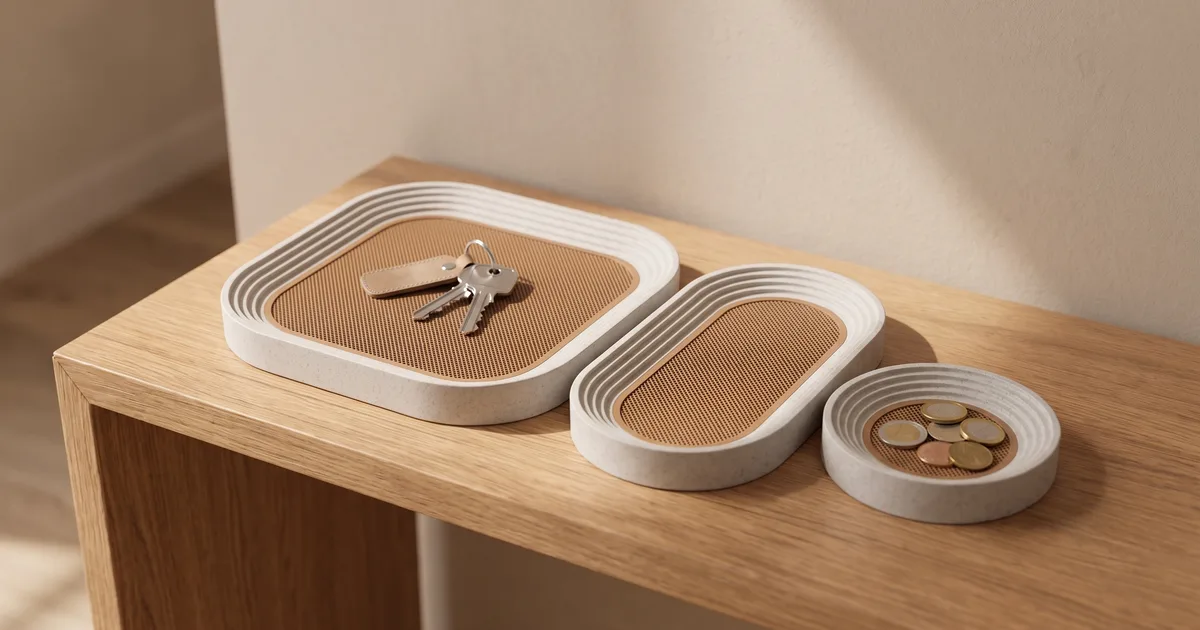
In the hallway, it is the square tray from the Gyroid set (£25 for all three pieces) that does the job. Its surface is the widest of the three: a complete keychain, the building badge and the phone fit side by side without overlapping. Its stepped rim, a succession of rings printed in slight offset, forms a border high enough that a coin won't go over the edge, and low enough that you can grab your keys without looking.
The bottom is not solid. It is a gyroid mesh, an open-mesh perforated surface, printed in a second colour. Two practical effects: a key placed on it does not slip when you set your bag beside it, and the texture catches the raking light of a hallway instead of reflecting a flat surface.
Why an open mesh bottom holds better than a smooth one
The gyroid is a minimal periodic surface, a geometry that folds back on itself without ever crossing. No mould can produce it: you would need to be able to remove the mould through the material. 3D printing builds it layer by layer, which makes it accessible on a £25 object.
On a catch-all tray, this mesh acts as a discreet non-slip surface. A smooth, slightly domed bottom, as many ceramic bowls have, lets small objects gather in the centre and then slide over each other. An open mesh holds them where you place them. We detail what shape brings to the strength of a 3D printed piece in is a 3D printed object really solid and durable.
On the desk: the oblong, along the keyboard
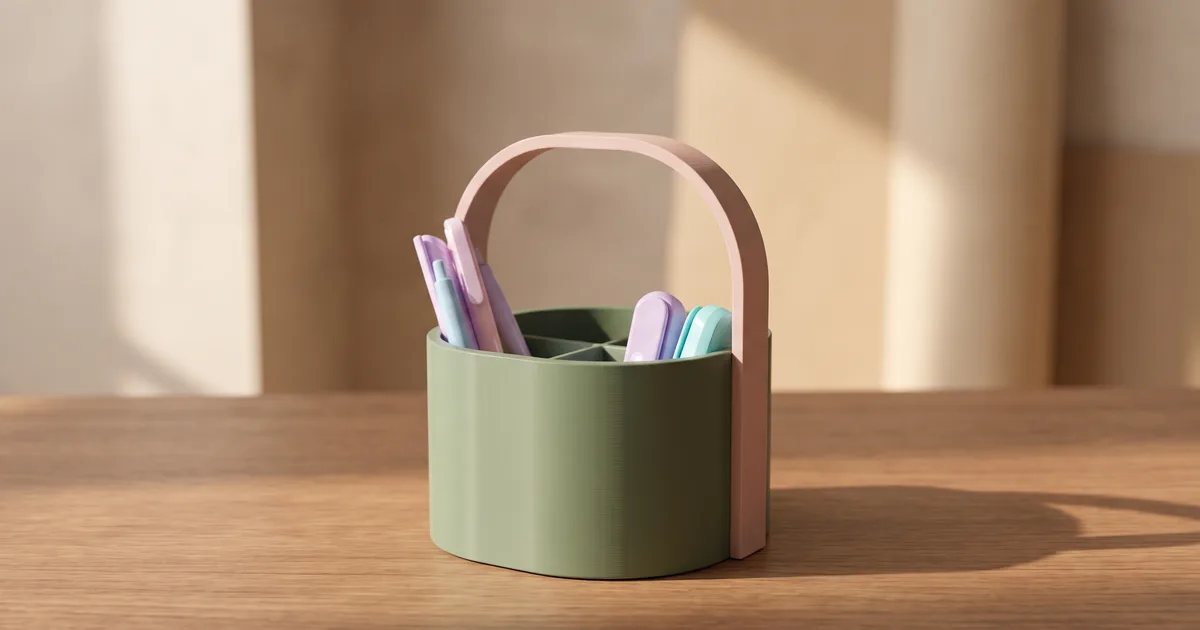
On a desk, the right place for a catch-all tray is the narrow strip between the keyboard and the table edge, or just to the right of the mouse. The oblong tray from the Gyroid set fits there without eating into your work area. It receives what has no category: the charging cable, the USB stick, a receipt, paperclips, your ring when you type.
The pen holder takes the rest. The Tandis (£18), 15 × 15 × 9 cm and 18 cm with its handle, is divided into four compartments by two crossed partitions, and its handle lets you carry it from the desk to the kitchen table. We detailed the complete setup of a work surface in desk storage: 5 design accessories for back to school.
On the bedside table: the round bowl, or the jewellery stand
The round bowl from the Gyroid set is the smallest of the three, and that is what makes it just right for a bedside table: it takes up the space of a cup. Watch, ring, earplugs, it is enough if you place few things.
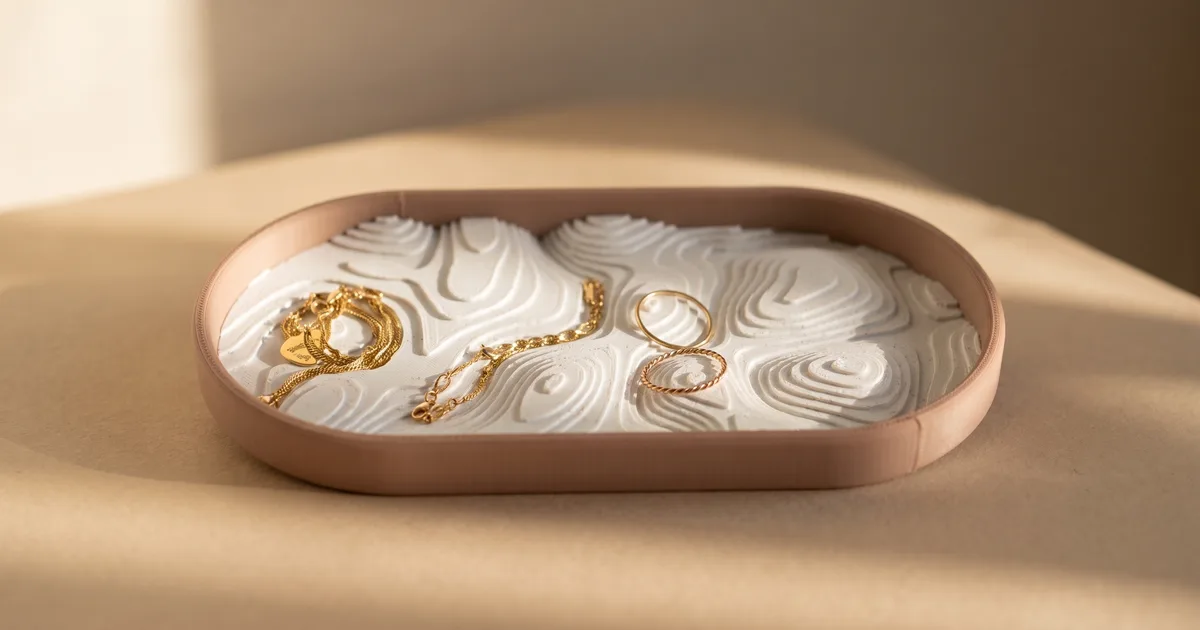
If you remove your jewellery in the evening, the Jewellery Stand (£10) is more suitable. It measures 23 × 12 cm, in an oblong tray with a proper rim, and its bottom is a wavy relief with hollows and bumps rather than a flat surface. Rings settle in the hollows instead of rolling towards the edge, chains rest in the grooves without tangling. The rim and bottom print in two different colours, which allows sharp contrast under bedside lighting, a light bottom under gold jewellery for example. On a dressing table, it pairs with compartment organisers we review in bathroom and make-up storage: 3D printed organisers.
In the living room: the catch-all tray that receives what you discard
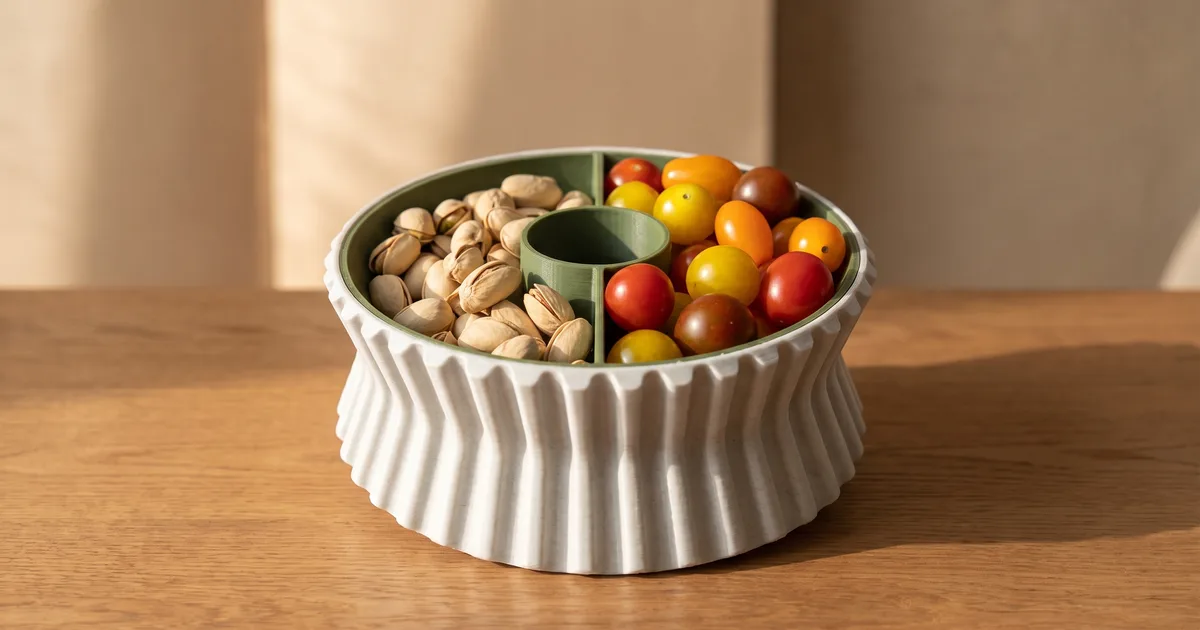
On a coffee table, the catch-all tray changes function: it receives less what you keep than what you get rid of. The Snacco (£17, Ø 15 cm) is a ribbed bowl divided into two compartments, with a well sunk in the middle. Pistachios on one side, cherry tomatoes on the other, shells and stones in the centre: the table stays neat without circulating a second bowl.
The Pistachio (£8) applies the same principle in a heart shape, with an upper tray for dried fruits and a reserve below for shells. It is the gift version of the idea, for a table for two.
When the console is already full, the wall takes over
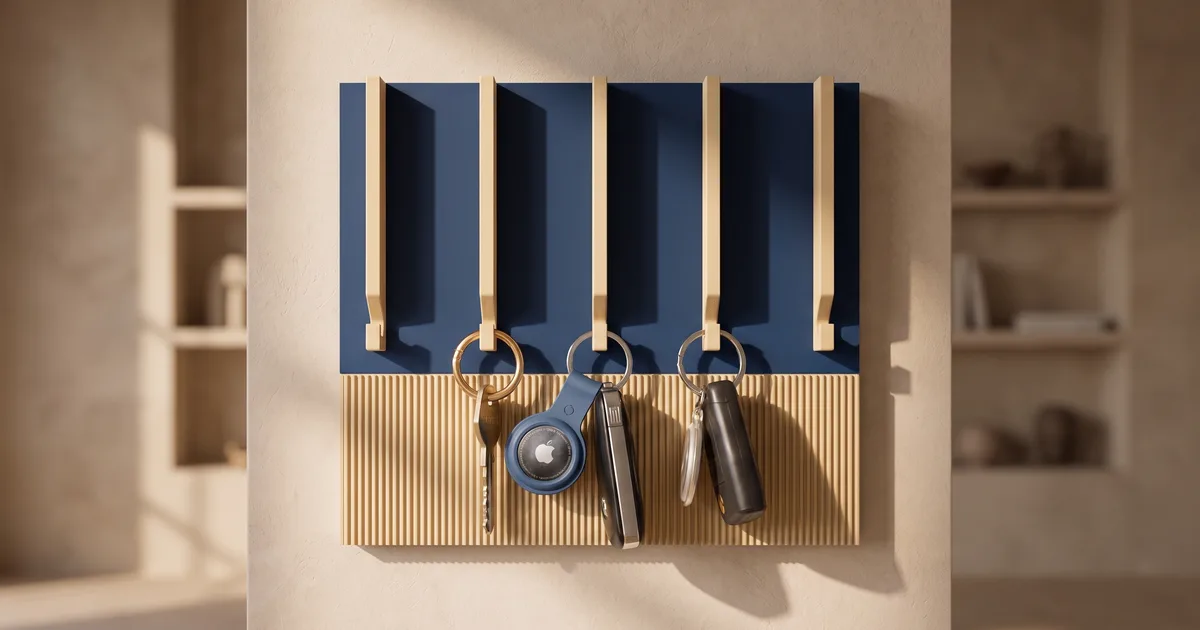
In a narrow hallway, the console is often already taken up by a lamp and the post. The Pianis (£34) then moves the keys to the wall: 25 × 22 × 2 cm, a row of vertical hooks above a ribbed band, printed in two colours. Keychains are suspended and visible, the tray stays free for the rest.
The two complement each other rather than exclude each other: keys on the wall, everything that sits flat in the tray just below.
Matching colours without thinking
These pieces share the same around twenty colours, mostly matte, with a few marbled finishes and a wood finish. The Gyroid, the Jewellery Stand and the Pianis being two-colour, the rim and bottom are chosen separately, and this choice does not change the price.
Two simple approaches. Tone on tone with the furniture: beige or wood on an oak console, matte black on a lacquered cabinet. Or the single accent: everything in a neutral, and the tray bottom in a bold colour, which only appears when the tray is empty. The logic is the same as that described for vases in personalised 3D vase colour: compose yours.
What these pieces withstand
A catch-all tray receives keys several times a day, it is an object of contact. Our pieces are printed in biosourced PLA, a bioplastic made from corn starch, with the colour in the material and not on the surface: a rubbed corner does not turn white. They clean with a damp cloth, and the Gyroid mesh dusts off with a soft brush.
The only limit is heat. PLA begins to soften around 55 to 60 degrees Celsius, which rules out the edge of a radiator or full sun behind a bay window in summer. On a hallway console or bedside table, the question does not arise. Recycled PETG, more tolerant of heat, will join our ranges in the coming months; the comparison of the two materials is in PLA or PETG, which material for which decor object.
Made to order
None of these pieces are in stock. Your order arrives at our Guérande workshop, the bobbins of the colours you chose are mounted on an available machine, the piece prints, then it is deburred and checked before packing. Allow 5 to 7 days before dispatch.
This is what allows you to order a matte black rim with a terracotta bottom without depending on what a warehouse planned in that combination. The entire range can be browsed on the home accessories page, how the workshop works is told in an hour in the RE3DLINE workshop, and terms by quantity to equip a hotel, practice or shop are on our professionals page.
Frequently asked questions
- Which catch-all tray format to choose for a hallway?
- A wide, low tray, placed exactly where your hand drops the keys. The square tray from the Gyroid Catch-all Tray set (£25 for all three pieces) holds a complete keychain, a building badge and a phone side by side, with a stepped rim high enough to hold coins and low enough to grab keys without looking.
- How many pieces does the Gyroid Catch-all Tray set contain?
- Three: a square tray with rounded corners, an oblong tray and a round bowl, for £25 for the set. The three formats correspond to three uses, the hallway, the desk and the bedside table, and nothing requires you to place them in the same room.
- Why an open mesh bottom rather than a smooth one?
- The gyroid mesh on the bottom acts as a discreet non-slip surface: a key placed on it does not slip. A smooth, slightly domed bottom lets small objects gather in the centre and slide over each other instead. This geometry cannot be moulded, only 3D printing produces it.
- Which catch-all tray for placing jewellery in the evening?
- The Jewellery Stand (£10, 23 × 12 cm) is more suitable than a bowl: its bottom is a wavy relief with hollows and bumps, where rings settle instead of rolling towards the edge and where chains rest without tangling.
- Can you choose the rim colour and bottom colour separately?
- Yes. The Gyroid, the Jewellery Stand and the Pianis are two-colour: the rim and bottom are chosen separately from around twenty colours, mostly matte, with a few marbled finishes and a wood finish. Choosing the colours does not change the price.
- How long to receive a 3D printed catch-all tray?
- 5 to 7 days before dispatch. No piece is in stock: your order arrives at our Guérande workshop, the bobbins of the colours you chose are mounted on an available machine, then the piece is printed, deburred and checked before packing.