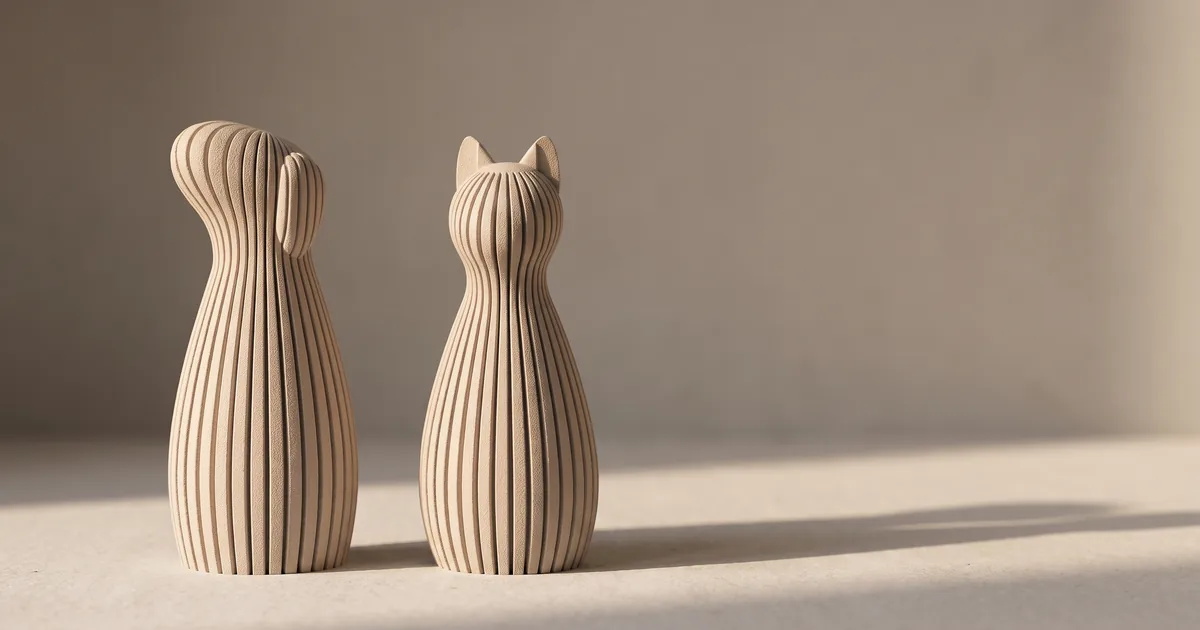
Dog statue: silhouette over portrait
A successful 3D-printed dog statue does not seek likeness, it captures gesture. Why the refined silhouette ages better than the frozen portrait, how to choose your colour, and where to place it in a home.
By L'atelier RE3DLINE
A 3D-printed dog statue is chosen first by its silhouette, not by its realism. Refined models, printed in biosourced PLA and traced with fine vertical striations, suit a contemporary interior where photorealistic portraiture ages poorly. Expect 6 cm in height and around twenty colours to choose from.
The likeness trap
Animal decoration has long had a poor reputation, and for good reason: most objects sold seek likeness. Detailed muzzle, sculpted fur, moist gaze, frozen posture. The result imitates a real animal without ever achieving it, and that gap shows every day on the living room shelf.
A silhouette, by contrast, pretends nothing. It holds a posture, the seated pose of a dog waiting, the verticality of a cat on its front paws, and abandons the rest. The brain completes everything on its own. It is the principle behind objects you keep: they leave room.
This is the line followed by our family and animal statues. The Dog statue fits in a palm, 6 cm tall, and reads at a glance, backlit or face-on. It does not tell the story of a specific breed, it tells the story of a dog.
Why these striations change everything
Look at one of our statues up close: its surface is traced with regular vertical lines, fine and sharp. This is not decoration added to the design, it is the trace of the process. A 3D printer builds an object layer after layer, and where many workshops seek to erase these layers through sanding or varnishing, we chose to make them the pattern.
These striations have a concrete effect on a small object: they catch raking light. A statue placed near a window changes appearance throughout the day, shadow glides from one ridge to the next, and the silhouette gains a relief that a smooth surface would never have had. It is also what immediately distinguishes a printed piece from a resin cast in series.
Colour does the rest
On a 6 cm object, colour weighs more heavily than form in overall perception. Around twenty colours are available on this piece, and they divide into two families.
Muted tones first: Beige, Ivory White, Wood, Marble Sandstone. Placed on light oak furniture or a white shelf, they read as a shade of material, not as an added object. It is the safe choice, the one that lets the silhouette work alone.
Accent tones next: Dark Blue, Khaki Green, Brown, Marble Brick. They embrace contrast and work better in an already layered setting, a bookshelf, a dark wall, a shelf where the object must exist among others.
A simple rule if you hesitate: buy the colour of your furniture, not the colour of your dog. A beige Labrador does not render better in beige, and a black statue on black furniture disappears.
Where to place it
This 6 cm format calls for proximity. A single statue at the centre of a console will seem lost, whereas a group of two or three pieces of different heights creates a scene. The dog and cat side by side work well, as does pairing with a family statue, taller, which provides vertical anchor.
Placements that work: a shelf at eye level, a desk edge, a bedside table, the edge of a bookshelf. Those that work less well: the floor, a south-facing windowsill, and any surface you wipe every day.
A word on durability, since the question comes up often: a piece printed in PLA is not fragile, it is rigid. It handles dusting without issue, but it breaks cleanly if it falls two metres onto tiles, where a flexible resin would bounce. We have detailed this behaviour in our article on the real durability of a 3D-printed object.
What we do not do
Let us be clear: we do not create a portrait of your dog from a photo. This service exists elsewhere, it relies on bespoke modelling, and it is not our trade. Ours consists of designing decorative objects, then printing them ourselves, made to order, in our Guérande workshop.
This constraint is also what makes the price possible. An animal statue starts at 3.00 € because it is produced in open series, with no dormant stock: the file is ready, the machine handles the colour you have chosen, and the piece ships within 5 to 7 days. A unique model, by contrast, counts in tens of euros of modelling before even the first layer.
However, if you are a florist, concept store or agency looking for an animal series in your brand colours, that is another matter, and that one we know how to handle: write to us.
Material and lifespan
All our statues are printed in biosourced PLA, a plastic derived from corn starch or sugar cane rather than petroleum. It is an indoor material: precise, matte, available in a wide colour range, but heat-sensitive, with softening beginning around 55 to 60 °C. We have devoted a full article to its environmental impact, nuances included: is PLA really ecological.
For objects destined to live outdoors, recycled PETG takes over, and it will join our workshop in the coming months. The division of roles between the two materials is explained here: PLA or PETG, which material for which decorative object.
In a living room, sheltered from direct sunlight, a PLA statue does not move. No yellowing, no warping, no colour loss: the colour is in the material, not on the surface, so there is no paint to chip. A dry cloth is enough for maintenance, and the ridges dust off with a soft brush.
Start small
From 3.00 € onwards, the animal statue is probably the simplest entry point to our collections. It is also, in practice, an easy gift: a sober object, made in France, which does not require knowing the precise tastes of the person you are giving it to.
And if you want to see the full family, from animals to couple silhouettes and family statues, everything is gathered in one place, each piece printed to order in around twenty colours.
RE3DLINE workshop, Guérande
Sources
The temperatures cited in this article are based on a public reference:
Prusa Research, comparative table of 3D printing materials (PLA deflection temperature): help.prusa3d.com
Frequently asked questions
- What size is your dog statue?
- It comes in one size only, 6 cm tall. It is a shelf or desk format, designed to sit near other objects rather than occupy a piece of furniture alone. The cat statue shares exactly the same footprint, which allows you to line them up.
- Can you print a statue of your own dog from a photo?
- No, we do not offer bespoke portrait from photo. Our animal statues are stylised silhouettes, designed as decorative objects. For a personalised series project, however, our professionals page describes what we can do.
- What colours should you choose for an animal statue?
- Around twenty colours are available on this piece, including Beige, Ivory White, Wood, Marble Sandstone, Brown, Khaki Green and Dark Blue. Sand and wood tones blend into a light interior, while Dark Blue and Khaki Green embrace contrast on a layered shelf.
- Can a 3D-printed statue stay outdoors?
- No. Our pieces are printed in biosourced PLA, an indoor material that softens around 55 to 60 °C and handles UV poorly. A statue placed behind a bay window in full summer sun is not in its place. Indoors, it lasts for decades.
- How long does it take to receive a statue?
- Allow 5 to 7 days of manufacturing before dispatch. Each statue is printed to order in our Guérande workshop, in Loire-Atlantique: nothing is stocked, the piece you receive was launched for you.